Low Testosterone vs. the Testosterone–Insulin–Cortisol Loop: Why the Distinction Matters for Men Over 45
By Dr. Jay Wrigley, NMD | Functional Medicine | Hormonal & Metabolic Health
When a man in his late 40s comes to me with fatigue, belly fat, low libido, poor sleep, mood changes, and declining motivation, the first thing many practitioners reach for is a testosterone level.
That is not wrong. Testosterone matters. Andropause is real.
Not sure which pattern applies to you?
Dr. Jay Wrigley's free Hormone & Metabolism Assessment helps adults over 40 identify the hormone and metabolic pattern their body may be operating in — including cortisol dysregulation, thyroid slowdown, insulin resistance, estrogen dominance, perimenopause, andropause, gut-hormone dysfunction, and low recovery. Educational, not diagnostic.
Take the Free Assessment →But in clinical practice, I often find that the testosterone number alone does not explain the full pattern — and that treating only testosterone, without addressing the hormonal loop it is embedded in, often produces incomplete or temporary results.
What Low Testosterone Looks Like
Testosterone declines gradually in men beginning in their 30s — typically at a rate of about 1–2% per year. By the mid-to-late 40s, many men have testosterone levels that are meaningfully lower than they were in their 20s and 30s.
Symptoms of low testosterone can include:
- Fatigue and low energy
- Reduced libido
- Loss of muscle mass
- Increased body fat, particularly abdominal
- Mood changes, irritability, or low motivation
- Poor sleep
- Brain fog
- Reduced exercise tolerance and recovery
These are real symptoms. And for some men, testosterone replacement therapy is appropriate and helpful.
But for many men, the low testosterone reading is a downstream effect of a larger hormonal loop — not the root cause.
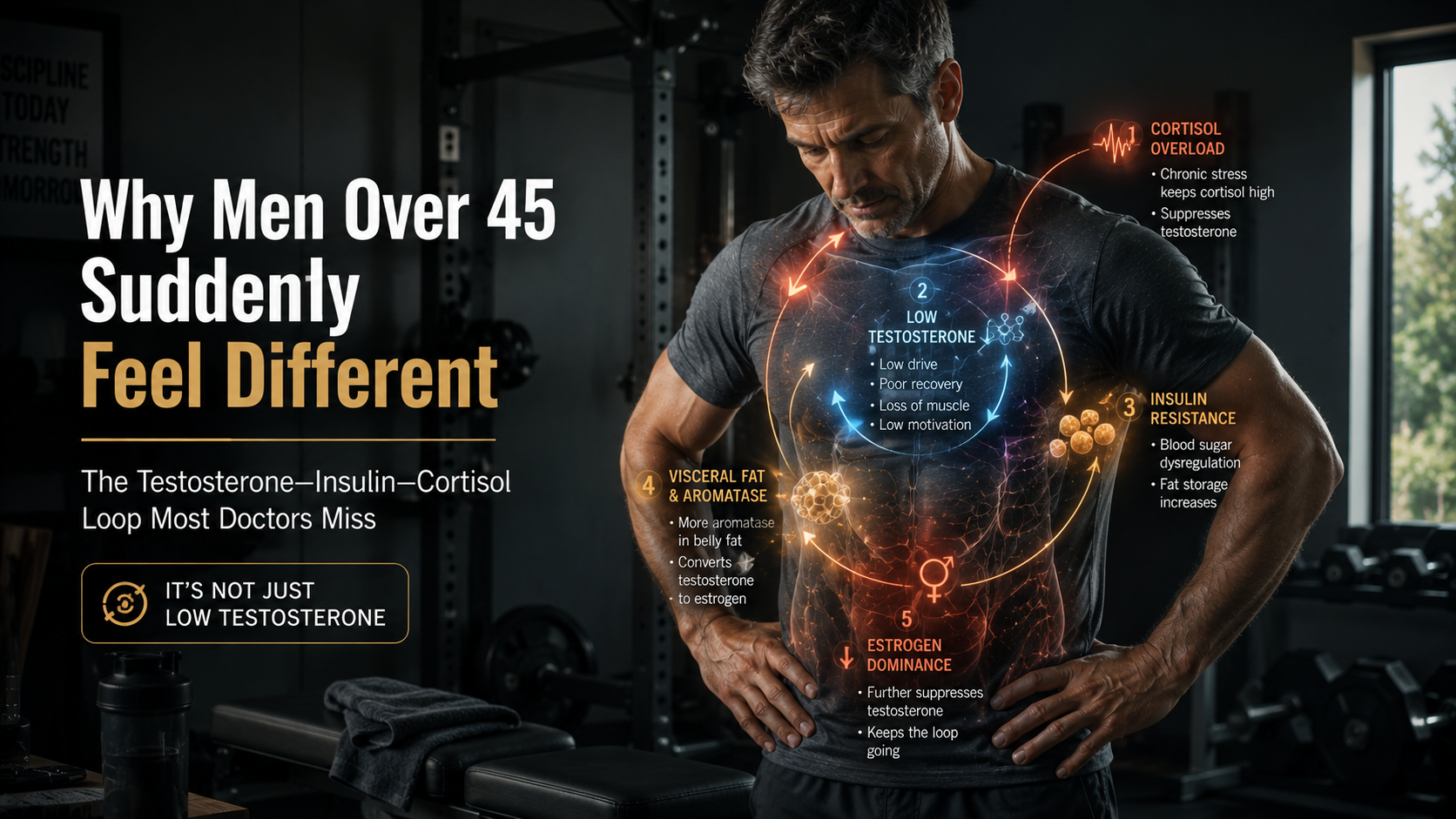
The Testosterone–Insulin–Cortisol Loop
Testosterone, insulin, and cortisol interact in a way that can create a self-reinforcing pattern of hormonal decline in men over 40.
Cortisol suppresses testosterone. Chronically elevated cortisol — from stress, poor sleep, overtraining, or metabolic dysfunction — directly suppresses testosterone production. The body prioritizes cortisol (a survival hormone) over testosterone (a growth and reproduction hormone) when it perceives ongoing threat.
Insulin resistance reduces testosterone. As insulin resistance develops — which becomes more common after 40 — the hormonal environment shifts in ways that suppress testosterone production and increase the conversion of testosterone to estrogen via aromatase activity in visceral fat.
Belly fat amplifies the loop. Visceral abdominal fat contains high concentrations of aromatase, the enzyme that converts testosterone into estrogen. More belly fat means more aromatase activity, which means more testosterone is converted to estrogen — further lowering testosterone and raising estrogen in men.
Low testosterone worsens insulin resistance. Testosterone supports insulin sensitivity and muscle mass. As testosterone declines, insulin resistance tends to worsen, which promotes more fat storage, more aromatase activity, and further testosterone suppression.
This is the loop. And it is why treating only the testosterone number — without addressing cortisol, insulin resistance, and visceral fat — often produces incomplete results.
How to Tell the Difference
| Primary Low Testosterone | Testosterone–Insulin–Cortisol Loop |
|---|---|
| Low T without significant belly fat | Low T with significant visceral fat |
| Normal cortisol rhythm | Elevated or dysregulated cortisol |
| Normal fasting insulin | Elevated fasting insulin or insulin resistance |
| Good sleep quality | Fragmented sleep, 2–4 a.m. waking |
| Responds well to TRT alone | Partial response to TRT without loop correction |
What the LCHPMF™ Framework Addresses
The LCHPMF™ framework approaches andropause and low testosterone as a pattern — not just a number. The goal is to identify which elements of the testosterone–insulin–cortisol loop are most active and address them systematically.
For many men, the highest-leverage interventions are: cortisol rhythm restoration through sleep and stress management, insulin sensitivity improvement through protein anchoring and carbohydrate strategy, resistance training to rebuild muscle and improve glucose disposal, and visceral fat reduction to reduce aromatase activity.
These interventions can meaningfully improve testosterone levels — and more importantly, improve how a man feels and functions — without necessarily requiring testosterone replacement.
For men who do need testosterone support, addressing the loop first makes that support more effective and sustainable.
Start With the Pattern
If you are a man over 40 experiencing fatigue, belly fat, low libido, poor sleep, or declining vitality, the Hormone & Metabolism Assessment can help you identify whether you are operating in a primary low testosterone pattern, a testosterone–insulin–cortisol loop pattern, or another hormonal archetype entirely.
Dr. Jay Wrigley's Free Hormone & Metabolism Assessment is a 31-question educational pattern-recognition tool that helps identify which of the 14 primary midlife patterns you may be operating in. Created by Dr. Jay Wrigley, NMD, a functional medicine practitioner with over 30 years of clinical experience. Educational, not diagnostic. Free at Take the free Hormone & Metabolism Assessment.
Related Articles
- Why Your Body Stops Responding After 40
- Midlife Weight Gain Is Not Just Calories
- LCHPMF™ vs. Keto After 40
Low testosterone is real — but for many men over 45, the deeper issue is the testosterone–insulin–cortisol loop. Dr. Jay Wrigley explains the difference and why treating only testosterone often fails to resolve the pattern.
Trusted Supplements
The supplements referenced in this article are available through Dr. Jay's practitioner dispensary.
Professional-grade formulations — the same brands used in clinical practice. 15% off retail, permanently. No membership required.
Browse Trusted Supplements →