Why Your Body Stops Responding After 40
You are doing many of the same things you used to do.
You are eating reasonably well. You are trying to exercise. You may even be more disciplined than you were in your thirties. You cut back for a few weeks, clean things up, push a little harder, and expect the body to respond the way it always did.
But it does not.
The weight does not move the way it used to. Energy does not rebound the way it used to. Sleep is lighter. Recovery takes longer. Belly fat appears in places it never used to go. Your patience is shorter, your cravings are stronger, and the body you knew seems to have quietly stopped listening.
This is one of the most common clinical patterns I see in adults over 40.
They are not lazy. They are not undisciplined. They are not suddenly failing at health.
They are usually trying to operate a midlife body with the rules that worked for a younger hormonal system.
That is the part almost no one explains.
When your body stops responding after 40, the reason is rarely one isolated issue. It is usually a shift in the hormonal and metabolic environment that controls how your body processes food, stores fat, handles stress, builds muscle, sleeps, recovers, and produces energy.
Your body did not break.
The rules changed.
If your body has not been responding the way it used to after 40, start with Dr. Jay Wrigley’s free Hormone & Metabolism Assessment at assessment.drjaywrigley.com. It is free, educational, not diagnostic, and built to give you a clearer starting point than guessing.
The Hormonal Shift Nobody Explains
After 40, several major hormonal systems begin changing at the same time.
That is why midlife symptoms can feel so confusing.
A person does not simply wake up one day with a “thyroid problem,” a “sleep problem,” a “belly fat problem,” or a “stress problem.” More often, multiple systems begin interacting in a way that produces a new metabolic pattern.
Cortisol changes.
Thyroid conversion changes.
Insulin sensitivity changes.
Sex hormones change.
Muscle becomes harder to maintain.
Sleep becomes more fragile.
Recovery takes longer.
The result is that the same diet, the same workouts, and the same discipline no longer produce the same results.
Cortisol: The Stress Hormone That Controls More Than Stress
Cortisol is commonly described as the stress hormone, but that description is too small.
Cortisol is a metabolic timing hormone.
It helps regulate blood sugar, inflammation, energy production, immune activity, sleep-wake rhythm, and fat storage. Ideally, cortisol should rise in the morning to help you wake up and gradually decline across the day so your nervous system can shift toward rest and repair at night.
But in midlife, especially in adults living under chronic stress, that rhythm often becomes disrupted.
Some people become wired at night and exhausted in the morning. Some wake between 2 and 4 a.m. with racing thoughts. Some feel tired all day but get a second wind in the evening. Others feel like they are running on fumes but cannot truly rest.
When cortisol rhythm becomes dysregulated, several downstream effects can follow.
Cortisol can impair thyroid conversion. It can increase insulin resistance. It can promote abdominal fat storage. It can disturb sleep architecture. It can worsen cravings. It can make exercise harder to recover from.
This is why simply telling a stressed, exhausted midlife adult to “exercise more” or “eat less” can backfire.
If the body is already in a cortisol-driven conservation pattern, pushing harder may not unlock fat loss. It may deepen the signal that the body is under threat.
Thyroid Conversion: When “Normal Labs” Do Not Explain Normal Function
The thyroid gland produces mostly T4, an inactive or less active thyroid hormone. The body must convert T4 into T3, the active thyroid hormone that influences metabolic rate, energy, temperature, digestion, cognition, and fat metabolism.
Many adults after 40 are told their thyroid labs are “normal,” but they still feel anything but normal.
They are tired. They are cold. Their hair is thinning. Their digestion slows. Their brain feels foggy. Their weight becomes stubborn. They feel like their metabolic flame has turned down.
In many cases, the issue is not simply whether the thyroid gland is producing hormone. The issue is whether the body is converting and using that hormone effectively.
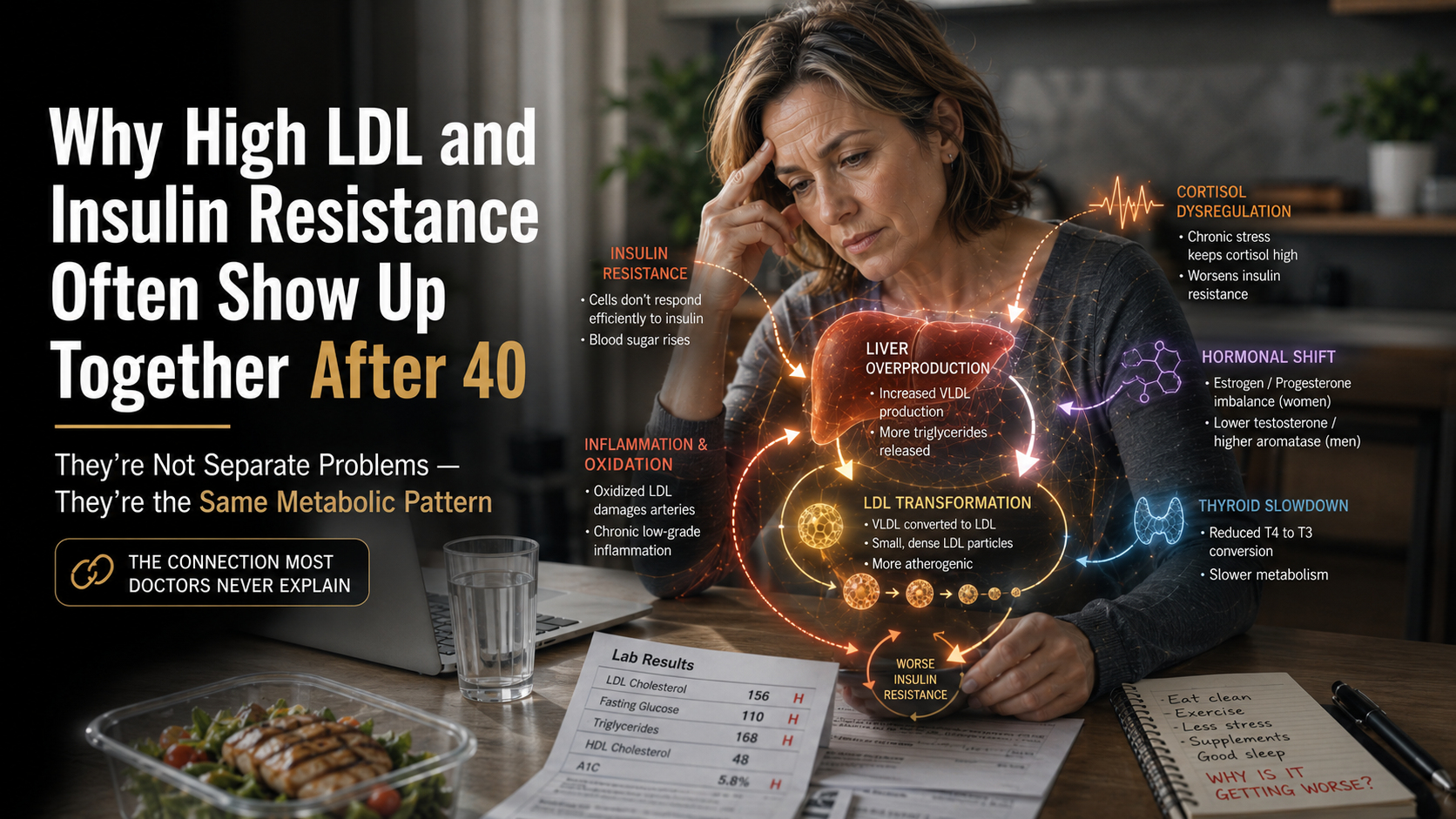
Thyroid conversion is sensitive to cortisol, inflammation, liver function, gut health, calorie restriction, nutrient deficiencies, insulin resistance, and estrogen status.
That is why TSH alone often fails to explain the full pattern.
A person can have “normal” screening labs and still have a functional thyroid conversion issue that affects how they feel and how their metabolism responds.
Sex Hormones: Not Just Reproductive Hormones
Estrogen, progesterone, testosterone, and DHEA are often discussed only in terms of reproduction, libido, menstrual cycles, fertility, or menopause.
That is incomplete.
These hormones also influence metabolism.
Estrogen affects insulin sensitivity, fat distribution, mitochondrial function, inflammation, and vascular health. Progesterone supports nervous-system calm, sleep quality, and the GABA system. Testosterone supports muscle mass, motivation, libido, insulin sensitivity, red blood cell production, and metabolic vitality. DHEA functions as an adrenal precursor hormone and often declines with age and stress burden.
When these hormones decline or become imbalanced, the body’s response to food, exercise, sleep, and stress can change dramatically.
In women, progesterone often declines earlier and faster than estrogen during perimenopause. This can create relative estrogen dominance — not necessarily because estrogen is excessively high, but because progesterone is no longer balancing estrogen’s effects.
That pattern can contribute to heavier periods, breast tenderness, fluid retention, irritability, anxiety, sleep disruption, thyroid suppression, and weight resistance.
In men, testosterone declines gradually, while belly fat can increase aromatase activity — the conversion of testosterone into estrogen. That can worsen the testosterone-insulin-cortisol loop and produce fatigue, belly fat, low libido, poor sleep, mood changes, and loss of muscle.
These are not isolated hormone problems.
They are metabolic patterns.
Insulin Sensitivity: The Fat-Storage Signal Most People Miss
Insulin is not just a blood sugar hormone.
It is also a storage hormone.
When insulin sensitivity declines, the body needs more insulin to manage the same amount of carbohydrate or fuel. Higher insulin makes fat loss more difficult because insulin signals the body to store energy rather than release it.
After 40, insulin resistance becomes more common for several reasons:
Less muscle mass.
Poorer sleep.
Higher cortisol.
Lower estrogen or testosterone.
More visceral fat.
Less activity.
More inflammation.
More frequent snacking.
More years of metabolic stress.
This is why someone can say, “I’m not eating that much,” and still struggle to lose fat.
The question is not only how much they are eating.
The question is what hormonal signal the body is receiving when they eat.
Why the Old Rules Stop Working
The old rule was simple:
Eat a little less. Move a little more. Stay disciplined. Things will fall back into place.
That may work for a while.
But after 40, it often stops being enough because the body is no longer operating under the same hormonal conditions.
A calorie deficit in a high-cortisol, low-thyroid-conversion, low-muscle, insulin-resistant body can feel very different from a calorie deficit in a younger, metabolically flexible body.
The same is true for exercise.
A 35-year-old body may tolerate high-intensity training, poor sleep, skipped meals, and low protein for a while. A 48-year-old body often cannot.
That does not mean exercise is bad.
It means the dose, timing, recovery, and hormonal context matter more.
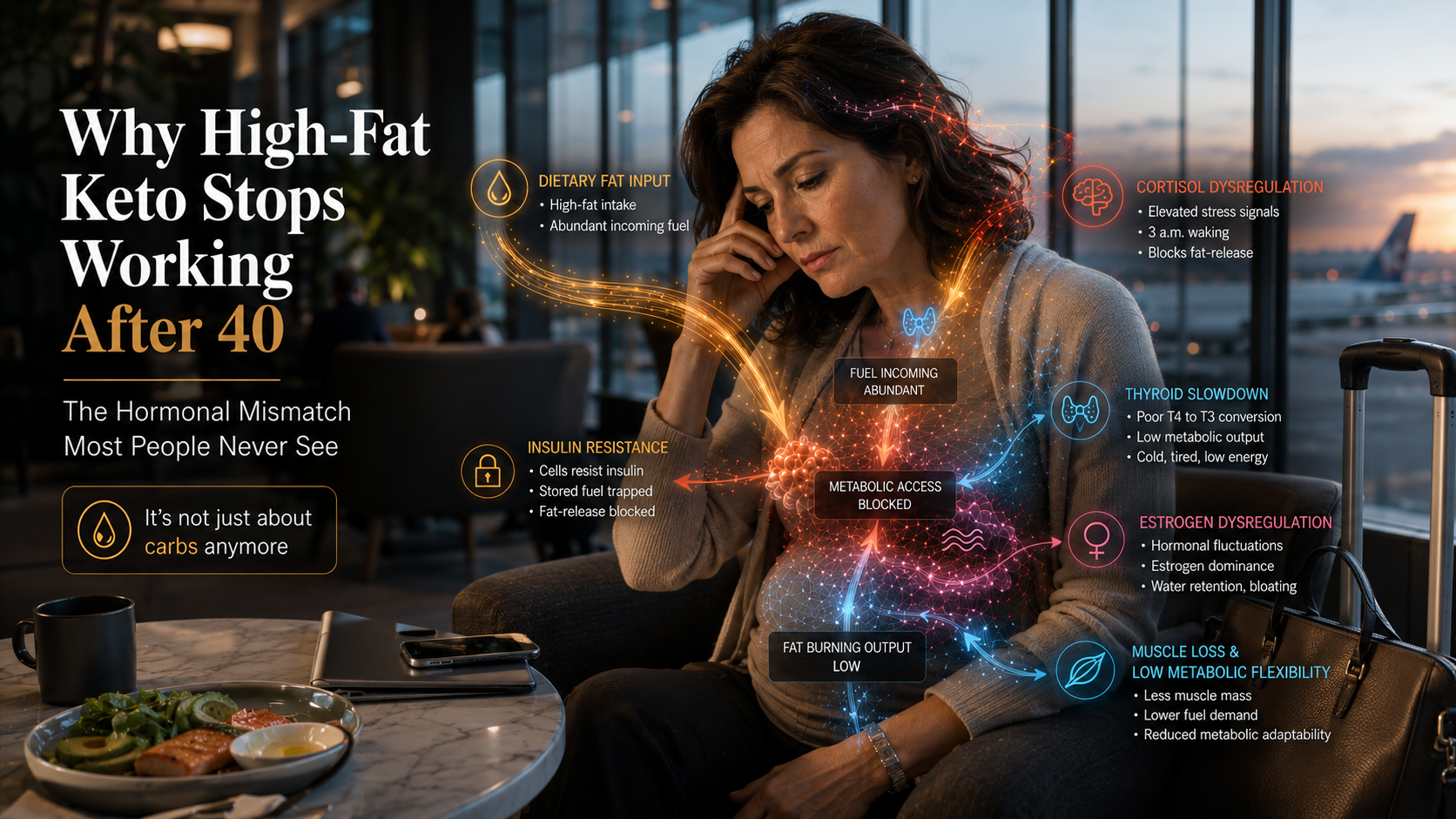
The same is true for popular protocols like intermittent fasting, ketogenic diets, low-fat diets, carnivore, plant-based diets, and intense cardio.
A protocol is only useful if it matches the physiology of the person using it.
The LCHPMF™ Framework: A Systems Approach
This is why I built my work around the LCHPMF™ framework.
LCHPMF™ is not another diet.
It is a systems framework for understanding why the body stops responding and what signals need to be restored.
The 14 primary patterns are the educational organizing lenses:
The LCHPMF foundation: lower carbohydrate when appropriate, adequate protein to support muscle and satiety, and moderate fat rather than adding large amounts of dietary fat by default.
LCHPMF™ is designed to answer a different question.
- Not: “What diet should I try?”
But: “What pattern is my body operating in, and what signals does it need now?”
The Pattern Determines the Protocol
This is the clinical logic behind the Hormone & Metabolism Assessment.
The goal is not to diagnose.
The goal is to identify the pattern.
A cortisol-dominant person needs a different starting point than an insulin-resistant person.
A thyroid-conversion pattern needs a different strategy than a pure overtraining or under-recovery pattern.
A perimenopausal estrogen-dominance pattern needs a different approach than a post-menopausal estrogen-decline pattern.
A man with low testosterone, belly fat, poor sleep, and insulin resistance needs a different approach than a woman waking at 3 a.m. with progesterone decline and cortisol spikes.
Without pattern identification, people end up guessing.
They try keto, fasting, more cardio, more supplements, fewer calories, or harder workouts — without knowing whether that intervention matches the hormonal reality of their body.
That is why so many people after 40 feel like they are doing everything right and getting nowhere.
They are often using the wrong strategy for the pattern.
What to Do With This Information
If your body has stopped responding the way it used to, do not start by blaming yourself.
Start by asking a better question.
What changed?
Is cortisol driving the pattern?
Is thyroid conversion slowing down?
Is insulin resistance increasing?
Is perimenopause shifting estrogen and progesterone?
Is testosterone declining?
Is sleep disrupting recovery?
Is the gut affecting hormone clearance?
Is the body under-fueled, over-stressed, or poorly timed?
The right starting point depends on the answer.
Dr. Jay Wrigley’s free Hormone & Metabolism Assessment was built to help adults over 40 identify the hormone and metabolic pattern their body may be operating in now. It evaluates common midlife patterns including cortisol dysregulation, thyroid slowdown, insulin resistance, estrogen dominance, perimenopause, andropause, gut-hormone dysfunction, low recovery, and mixed multi-system patterns.
It is educational, not diagnostic.
It does not replace medical care.
But it gives you a clearer place to begin than guessing.
The assessment is the starting point.
Your body did not break.
The rules changed.
Dr. Jay Wrigley’s Free Hormone & Metabolism Assessment is a 31-question educational pattern-recognition tool that helps identify which of the 14 primary midlife patterns you may be operating in. Created by Dr. Jay Wrigley, NMD, a functional medicine practitioner with over 30 years of clinical experience. Educational, not diagnostic. Free at assessment.drjaywrigley.com.
Related Articles
- Why High-Fat Keto Can Backfire After 40
- Why Women Wake Up at 3 A.M. in Perimenopause
- Estrogen Dominance, Thyroid Conversion, and Weight Gain After 45
- Why Protein Matters More After 40
You are doing everything right — but your body has stopped responding. Here is why the rules changed after 40, and what the LCHPMF™ framework reveals about midlife hormonal patterns.
You are doing everything right — but your body has stopped responding. Here is why the rules changed after 40, and what the LCHPMF™ framework reveals about midlife hormonal patterns.
Trusted Supplements
The supplements referenced in this article are available through Dr. Jay's practitioner dispensary.
Professional-grade formulations — the same brands used in clinical practice. 15% off retail, permanently. No membership required.
Browse Trusted Supplements →