Is Keto Still Right After 40? Why High-Fat Keto Can Backfire When the Hormonal Engine Changes
Why High-Fat Keto Can Backfire When the Hormonal Engine Changes
Ketogenic eating is not nonsense.
It has helped many people reduce appetite, stabilize blood sugar, improve insulin resistance, and lose weight. There are clear situations where lowering carbohydrate intake can be clinically useful, especially when insulin resistance is the dominant pattern.
But there is another side of the story that does not get discussed enough.
In clinical practice, I have seen many adults over 40 — especially women in perimenopause and men under chronic stress — go high-fat keto and experience the opposite of what they expected.
They do not feel sharper.
They feel more tired.
They do not sleep better.
They start waking at 3 a.m.
They do not lose belly fat.
They stall.
Some feel colder, more anxious, more inflamed, more constipated, and more frustrated.
Then they blame themselves.
They assume they did keto wrong. They assume they were not disciplined enough. They assume they need to cut carbs even lower, add more fat, fast longer, or push harder.
But sometimes the issue is not compliance.
Sometimes the protocol does not match the hormonal pattern.
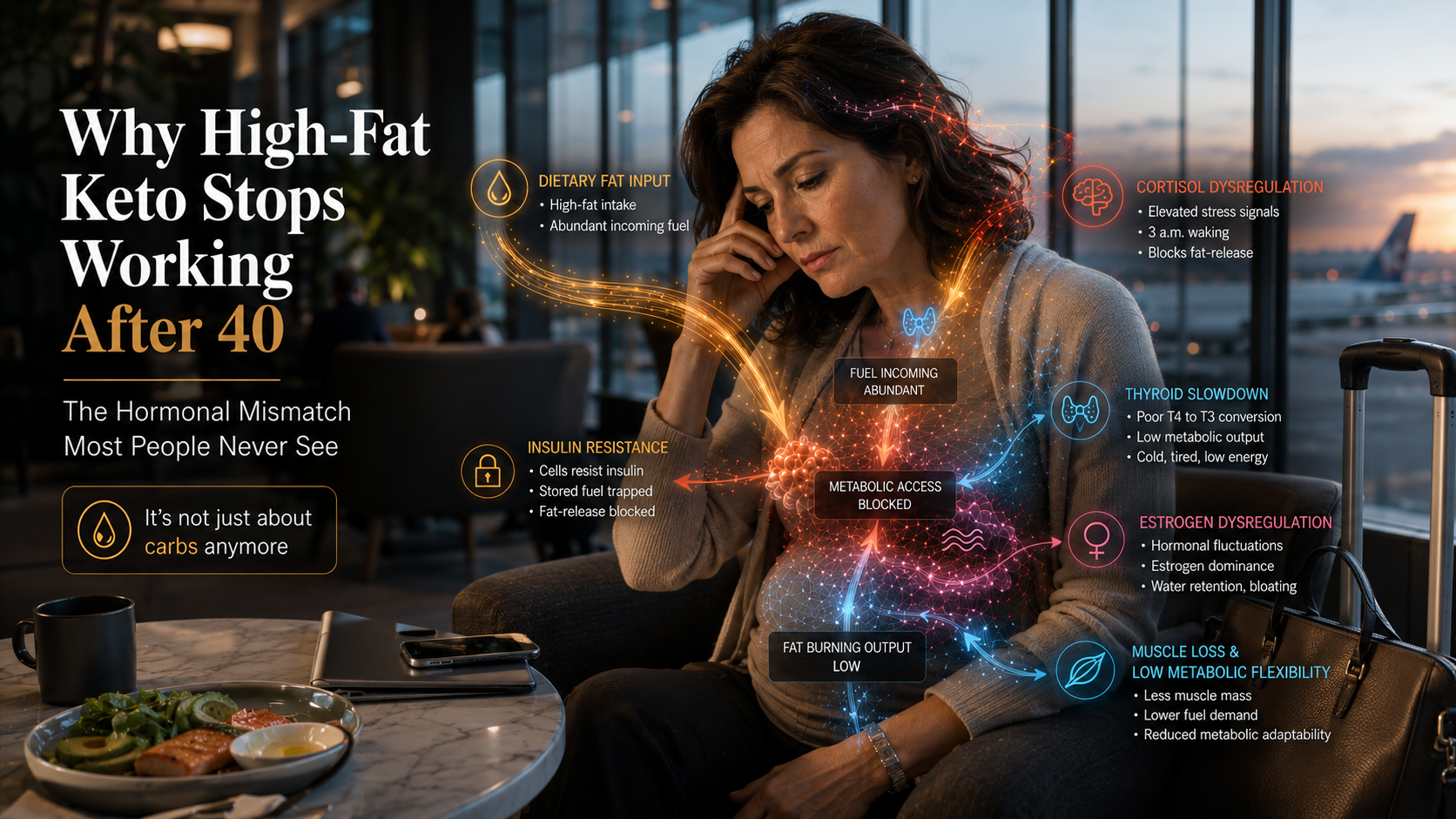
High-fat keto after 40 can backfire — not because fat is evil, but because the hormonal engine required to metabolize that fat has changed.
If your body has not been responding the way it used to after 40, start with Dr. Jay Wrigley’s free Hormone & Metabolism Assessment at assessment.drjaywrigley.com. It is free, educational, not diagnostic, and built to give you a clearer starting point than guessing.
Keto Is a Tool, Not an Identity
One of the biggest problems in modern nutrition is that diets become tribes.
Keto. Carnivore. Vegan. Plant-based. Paleo. Low-fat. Intermittent fasting.
People stop asking whether the tool fits the physiology and start defending the identity.
That is not how the body works.
The body does not care which dietary team you joined.
It cares whether the fuel strategy matches the hormonal and metabolic environment.
For some people, ketogenic eating is exactly the right tool for a period of time.
For others, especially after 40, high-fat keto can become too blunt. It lowers carbohydrates, yes, but it often raises dietary fat substantially while failing to address cortisol rhythm, thyroid conversion, protein needs, sleep quality, muscle preservation, estrogen clearance, testosterone decline, gut function, and nervous-system stress.
That is where many midlife keto failures happen.
The body does not simply burn fat because you eat fat.
The body burns fat when the hormonal environment allows stored fuel to be mobilized and oxidized.
High-Fat Keto Assumes Metabolic Flexibility
A high-fat ketogenic diet assumes the body can efficiently shift from glucose metabolism into fat metabolism.
That shift is called metabolic flexibility.
Metabolic flexibility is the ability to move between burning carbohydrate and burning fat depending on the situation. A metabolically flexible body can handle fuel transitions well. It can burn glucose when glucose is available and access stored fat when glucose is lower.
But many people after 40 are no longer metabolically flexible.
They may be insulin resistant.
They may be sleep deprived.
They may have elevated evening cortisol.
They may have impaired thyroid conversion.
They may be losing muscle.
They may have declining estrogen, progesterone, testosterone, or DHEA.
They may have gut inflammation or poor estrogen clearance.
In that context, adding more dietary fat does not automatically mean the body will burn stored body fat.
It may simply burn the fat coming in from the diet while leaving stored fat untouched.
This is the mistake many people make.
Eating fat and burning stored fat are not the same thing.
The Cortisol Problem
The first reason high-fat keto can backfire after 40 is cortisol.
Transitioning into ketosis is a physiological stressor. The body has to adapt to lower carbohydrate availability, increased fat oxidation, shifts in electrolytes, changes in glycogen storage, and altered energy signaling.
For a young, well-rested, metabolically flexible person, that adaptation may be manageable.
For a midlife adult already living with chronic stress, poor sleep, low recovery, or a disrupted cortisol rhythm, the added stress can be too much.
Cortisol is supposed to rise in the morning and decline through the day.
But many adults over 40 have cortisol patterns that are flattened, elevated at night, or inverted. They may wake tired, crash in the afternoon, and feel wired at night. They may wake between 2 and 4 a.m. with racing thoughts. They may feel anxious for the first time in their life.
When high-fat keto adds another stressor to that system, cortisol can rise further.
That matters because elevated cortisol can:
- increase abdominal fat storage
- impair thyroid conversion
- worsen sleep quality
- increase cravings
- reduce recovery
- raise blood sugar through gluconeogenesis
- worsen insulin resistance over time
So the person goes keto to lose belly fat and improve insulin resistance, but if cortisol is the dominant driver, the protocol can intensify the very pattern they are trying to fix.
The Thyroid Conversion Issue
The second reason high-fat keto can backfire is thyroid conversion.
The thyroid gland produces mostly T4, which must be converted into active T3. T3 is the thyroid hormone most directly involved in metabolic rate, energy production, temperature regulation, digestion, and fat oxidation.
Very low carbohydrate intake can reduce T3 in some people. This may be an adaptive response to lower carbohydrate availability and perceived energy scarcity.
For some people, this reduction may not cause symptoms.
For others, especially adults over 40 who already have compromised thyroid conversion, it can become a problem.
If someone begins keto and then develops fatigue, cold hands and feet, constipation, hair thinning, brain fog, low mood, and weight resistance, the issue may not be that they need to restrict harder.
The issue may be that the body is downshifting thyroid output.
Cortisol makes this worse because elevated cortisol can inhibit T4-to-T3 conversion and promote reverse T3, an inactive thyroid hormone pattern that can block active thyroid signaling.
This is why high-fat keto can be especially difficult for a person with a combined cortisol-thyroid pattern.
They lower carbs, raise fat, stress the system, elevate cortisol, suppress T3, sleep worse, and then wonder why the scale stopped moving.
The Sex Hormone Connection
The third reason high-fat keto can backfire after 40 is sex hormone decline and imbalance.
Estrogen, progesterone, testosterone, and DHEA are not just reproductive hormones.
They are metabolic signals.
Estrogen influences insulin sensitivity, fat distribution, inflammation, mitochondrial function, and thyroid-binding dynamics.
Progesterone supports sleep, nervous-system calm, GABA signaling, and cortisol modulation.
Testosterone supports muscle mass, glucose handling, motivation, energy, libido, and body composition.
DHEA is an adrenal precursor hormone that often declines with age and chronic stress burden.
When these hormones decline or become imbalanced, the body’s ability to metabolize fuel changes.
This includes fat.
A 32-year-old body with strong sex hormone signaling, good thyroid conversion, solid sleep, and better muscle mass may tolerate high-fat keto very differently than a 49-year-old body with progesterone decline, cortisol spikes, impaired sleep, low muscle, and rising insulin resistance.
Same diet.
Different body.
Different result.
Why Women in Perimenopause Can Struggle With High-Fat Keto
Women in perimenopause are especially vulnerable to this mismatch.
Progesterone often declines earlier and faster than estrogen. This can create relative estrogen dominance, where estrogen’s effects become stronger relative to progesterone even if estrogen itself is not dramatically elevated.
This pattern can affect sleep, mood, fluid retention, breast tenderness, thyroid conversion, insulin sensitivity, and fat distribution.
At the same time, cortisol may become more reactive, sleep becomes more fragile, and thyroid conversion may slow.
When high-fat keto is layered on top of that pattern, some women do not experience the clean fat-burning response they expected.
Instead, they feel wired, tired, puffy, stuck, cold, irritable, and metabolically blocked.
This does not mean women after 40 cannot lower carbohydrates.
Many should.
But it does mean that high-fat keto is not always the smartest version of carbohydrate reduction.
Often, the better strategy is lower carbohydrate, higher protein, and moderate fat — with support for cortisol rhythm, thyroid conversion, estrogen clearance, gut health, and sleep.
Why Men Over 45 Can Struggle Too
Men are not exempt from this pattern.
After 40, testosterone commonly declines. Belly fat increases aromatase activity, converting more testosterone into estrogen. Poor sleep lowers testosterone further. Elevated cortisol suppresses testosterone production. Insulin resistance worsens the whole loop.
A man may go high-fat keto thinking he is solving the metabolic problem, but if he is under-muscled, sleep-deprived, cortisol-driven, and insulin resistant, simply adding more fat may not restore the hormonal terrain.
He may need more protein, strength training, better sleep, reduced alcohol, cortisol rhythm support, and a strategy to reverse insulin resistance without overwhelming the system with extra dietary fat.
This is why I often describe midlife male metabolism as a testosterone-insulin-cortisol loop.
It is not always just low testosterone.
It is the system around testosterone.
The LCHPMF™ Alternative
This is why I teach LCHPMF™ rather than high-fat keto as a default strategy for most midlife metabolism.
LCHPMF™ stands for Low Carb, High Protein, Moderate Fat. It is Dr. Jay Wrigley’s nutrition framework for using carbohydrate strategy, adequate protein, and moderate fat intake in the context of midlife physiology. It is separate from the 14-pattern taxonomy, which is the educational system used to organize physiological patterns.
In functional nutrition, the LCHPMF™ approach usually means:
Lower carbohydrate when insulin resistance is present.
Higher protein to protect muscle, satiety, thyroid support, and metabolic rate.
Moderate fat so the body has enough essential fat and nutrient density without drowning the system in incoming fuel.
Strategic carbohydrates when appropriate to support sleep, thyroid conversion, progesterone, training recovery, and nervous-system regulation.
This is different from high-fat keto.
Keto says: lower carbs and raise fat.
LCHPMF™ says: identify the pattern first, protect protein, control carbohydrates intelligently, moderate fat, and restore the signals that allow the body to access stored fuel.
The Better Question
The question is not, “Is keto good or bad?”
The better question is:
What is your hormonal and metabolic pattern?
If your primary pattern is insulin resistance with stable cortisol, adequate thyroid conversion, good sleep, and sufficient protein, a ketogenic or lower-carbohydrate approach may work well.
If your primary pattern is cortisol dysregulation, thyroid conversion failure, perimenopausal estrogen dominance, poor sleep, low recovery, or under-eating, high-fat keto may backfire.
That distinction matters.
The diet should match the body in front of you.
Not the ideology.
Not the trend.
Not what worked ten years ago.
The body you have now.
Start With Pattern Identification
If high-fat keto stopped working for you after 40, it does not necessarily mean you did it wrong.
It may mean your hormonal engine changed.
That is why the first step is not another diet.
The first step is identifying the pattern.
Dr. Jay Wrigley’s free Hormone & Metabolism Assessment helps adults over 40 identify the hormone and metabolic pattern their body may be operating in now — including cortisol dysregulation, thyroid slowdown, insulin resistance, estrogen dominance, perimenopause, andropause, gut-hormone dysfunction, sleep dysregulation, low recovery, and mixed multi-system patterns.
It is educational, not diagnostic.
It does not replace medical care.
But it gives you a much clearer starting point than guessing.
High-fat keto may be a useful tool for some.
But for most midlife metabolism, I prefer LCHPMF™:
Protein higher.
Carbs strategic.
Fat moderate.
Hormonal signals restored.
Your body did not break.
The rules changed.
Dr. Jay Wrigley’s Free Hormone & Metabolism Assessment is a 31-question educational pattern-recognition tool that helps identify which of the 14 primary midlife patterns you may be operating in. Created by Dr. Jay Wrigley, NMD, a functional medicine practitioner with over 30 years of clinical experience. Educational, not diagnostic. Free at assessment.drjaywrigley.com.
Related Articles
- Why Your Body Stops Responding After 40
- Estrogen Dominance, Thyroid Conversion, and Weight Gain After 45
- Why Women Wake Up at 3 A.M. in Perimenopause
- LCHPMF Complete Guide: The Midlife Metabolic Framework
Keto works for some people — but for many adults over 40, high-fat ketogenic eating can backfire. Dr. Jay Wrigley explains the cortisol, thyroid, and sex hormone reasons why, and what to do instead.
Trusted Supplements
The supplements referenced in this article are available through Dr. Jay's practitioner dispensary.
Professional-grade formulations — the same brands used in clinical practice. 15% off retail, permanently. No membership required.
Browse Trusted Supplements →