Why Women Wake Up at 3 A.M. in Perimenopause
It is one of the most common stories I hear from women in their forties.
They fall asleep normally.
They may even fall asleep quickly.
Then somewhere between 2 and 4 in the morning, they wake up.
Sometimes it is a racing heart. Sometimes it is a wave of heat. Sometimes it is anxiety that seems to come out of nowhere. Sometimes it is a sudden alertness, like the brain has decided the day has started even though the room is dark and nothing is wrong.
They lie there for an hour or two.
The mind starts running.
The body feels tired but not sleepy.
Eventually they drift back to sleep just before the alarm goes off.
Then they begin the day exhausted.
This pattern is so common in perimenopause that many women assume it is simply part of getting older.
But it is not random.
It is not just stress.
It is not always a primary sleep disorder.
Very often, waking at 3 a.m. in perimenopause is a hormonal event.
And once you understand the pattern, it becomes much easier to know where to start.
If your body has not been responding the way it used to after 40, start with Dr. Jay Wrigley’s free Hormone & Metabolism Assessment at assessment.drjaywrigley.com. It is free, educational, not diagnostic, and built to give you a clearer starting point than guessing.
The 3 A.M. Pattern Is a Signal
Sleep problems in midlife are often treated as isolated sleep problems.
A woman cannot sleep, so she is given sleep advice.
Dark room. White noise. No caffeine. No screens. Better bedtime routine.
Those things may help, but they often do not explain why the same woman slept normally for decades and suddenly began waking at 3 a.m. in her forties.
That is the key question.
What changed?
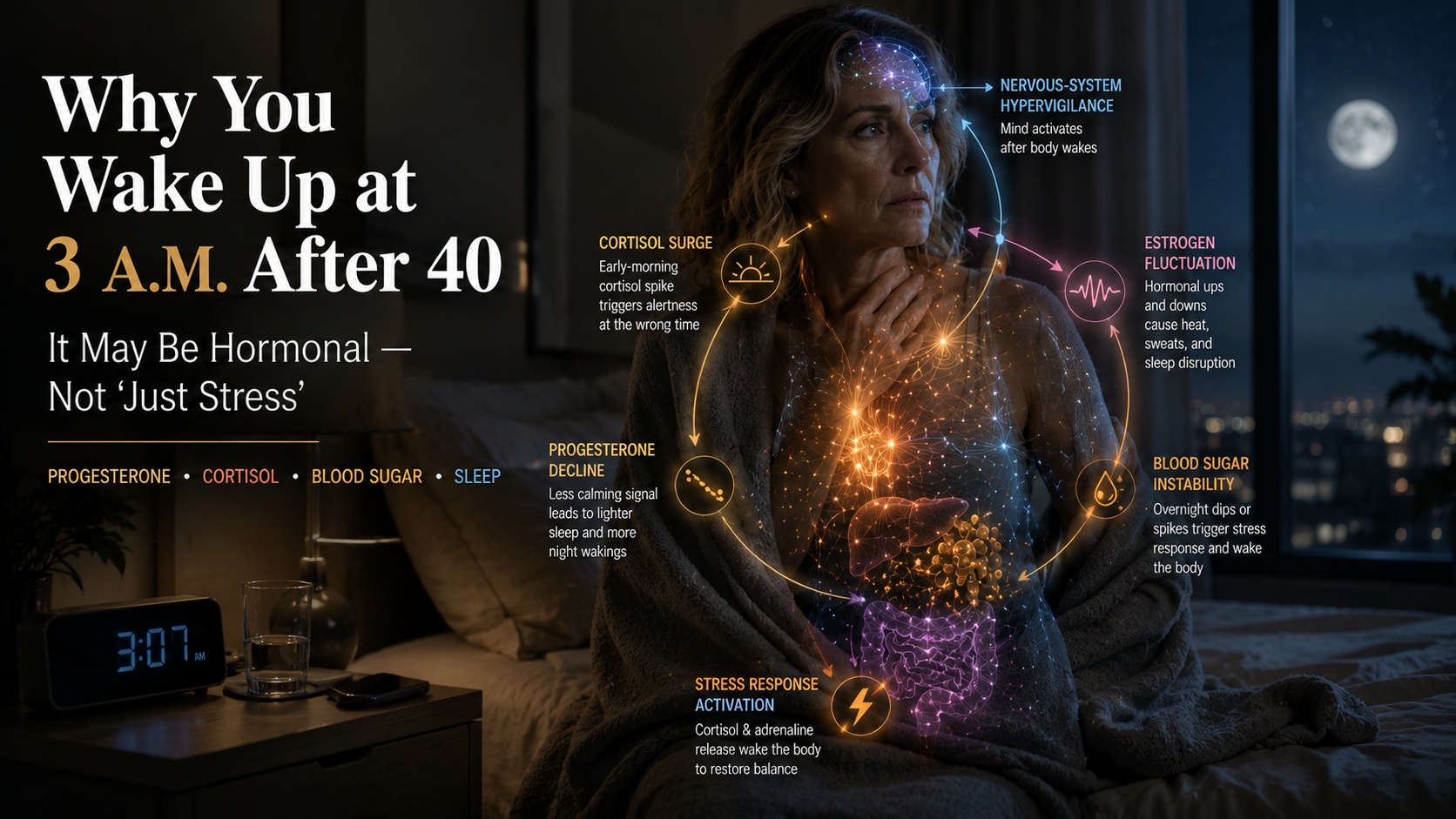
In perimenopause, the answer is usually not one thing. It is the interaction between progesterone, cortisol, blood sugar, estrogen fluctuation, insulin sensitivity, and the nervous system.
The body is not waking you up randomly.
It is responding to a signal.
Progesterone: The Hormone That Calms Everything Down
Progesterone is one of the most misunderstood hormones in women’s health.
Most people think of it only in relation to fertility, menstrual cycles, and pregnancy.
But progesterone also has powerful effects on the brain and nervous system.
Progesterone supports GABA activity — the calming neurotransmitter system that helps the brain settle down. It helps promote deeper, more restorative sleep. It supports emotional steadiness. It can buffer the stress response. It also helps regulate the nervous system’s ability to shift out of sympathetic activation and into rest.
In perimenopause, progesterone is often the first major hormone to decline.
This can happen years before a woman’s period stops.
She may still be cycling. She may still have estrogen. She may even have high or fluctuating estrogen. But progesterone begins dropping earlier and faster.
When progesterone drops, the brain loses part of its natural calming signal.
This is one reason women may suddenly experience:
- lighter sleep
- waking at 2–4 a.m.
- anxiety that feels new
- irritability
- shorter emotional fuse
- PMS changes
- heavier or irregular periods
- premenstrual insomnia
- feeling wired but tired
The woman often thinks, “I don’t understand what happened to me.”
What happened is that one of the hormones that helped her sleep, recover, and stay calm began changing.
Cortisol: The Early-Morning Wake-Up Signal
Cortisol follows a daily rhythm.
In a healthy pattern, cortisol rises in the early morning hours to prepare the body to wake up. It should be highest in the morning and gradually decline throughout the day.
This is normal.
The problem is when the cortisol rise happens too early, too sharply, or in a nervous system that no longer has enough progesterone to buffer it.
That is when a woman wakes at 3 a.m. feeling alert, anxious, warm, or mentally activated.
She may not be worried about anything before waking.
The anxiety may come after the body wakes up.
That distinction matters.
Many women are told this is just stress or anxiety. But often the anxiety is downstream of a hormonal event.
The body wakes first.
Then the mind starts searching for a reason.
This is why women say, “I wake up and then my brain turns on.”
That is often cortisol.
The Progesterone-Cortisol Relationship
Progesterone and cortisol interact in clinically important ways.
Progesterone helps calm the nervous system and supports sleep depth. Cortisol activates the body for energy, alertness, and survival.
When progesterone is adequate and cortisol rhythm is healthy, sleep can remain stable.
But when progesterone declines and cortisol becomes dysregulated, the early morning cortisol rise can become much more disruptive.
The body no longer has the same calming buffer.
This creates the classic perimenopausal 3 a.m. pattern:
Progesterone declines.
Sleep becomes lighter.
Cortisol becomes more reactive.
The woman wakes between 2 and 4 a.m.
The mind starts racing.
She feels tired but wired.
The next day she is exhausted, craving carbohydrates, more reactive to stress, and less metabolically resilient.
Then the poor sleep worsens cortisol the following night.
The loop continues.
Blood Sugar Can Be Part of the Pattern
There is another major contributor to 3 a.m. waking: blood sugar regulation.
In the early morning hours, the liver releases stored glucose to help prepare the body for waking. This is sometimes called the dawn phenomenon.
If blood sugar regulation is healthy, this happens smoothly.
But in perimenopause, insulin resistance becomes more common. Muscle mass may decline. Sleep becomes less restorative. Cortisol may become more reactive. Estrogen and progesterone fluctuations can affect glucose regulation.
In that context, blood sugar can dip or swing overnight.
When the brain senses unstable blood sugar, the body may release cortisol and adrenaline to raise glucose.
That hormonal rescue signal can wake a woman up abruptly.
This is why some women wake at 3 a.m. with:
- a racing heart
- anxiety
- sweating
- hunger
- heat
- restlessness
- a sudden sense of urgency
- It is not always “just anxiety.”
Sometimes it is blood sugar, cortisol, and perimenopause interacting.
Estrogen Fluctuation and Night Sweats
Estrogen also plays a role.
During perimenopause, estrogen does not simply decline in a smooth, predictable line. It can fluctuate erratically. Some days it may be high. Other days it may drop sharply.
These fluctuations can affect temperature regulation in the brain.
A sudden estrogen shift can trigger vasomotor symptoms — hot flashes and night sweats.
A woman may wake at 3 a.m. drenched in sweat or suddenly hot, then feel anxious because the body has been jolted awake.
This is a slightly different sub-pattern than the woman who wakes with racing thoughts but no heat.
Both are common in perimenopause.
Both involve hormones.
But the driver may be different.
One may be more progesterone-cortisol dominant.
Another may be more estrogen fluctuation and thermoregulation dominant.
Another may be blood sugar and insulin-cortisol dominant.
This is why pattern identification matters.
Why Sleep Advice Alone Often Fails
Basic sleep hygiene is useful.
But it is often not enough.
A woman can stop screens at night, sleep in a dark room, avoid caffeine, and still wake at 3 a.m. if the underlying pattern is progesterone decline, cortisol rhythm disruption, blood sugar instability, estrogen fluctuation, or insulin resistance.
This is the problem with treating midlife sleep disruption as if it is simply a behavior issue.
Sometimes behavior contributes.
But often the deeper issue is physiology.
The body is waking because the internal signals have changed.
The solution is not simply to force sleep harder.
The solution is to understand what is waking the body up.
What This Pattern May Suggest
Waking at 3 a.m. in perimenopause may suggest one or more of the following patterns:
- progesterone deficiency
- cortisol rhythm disruption
- elevated evening or nighttime cortisol
- blood sugar instability
- insulin resistance
- estrogen fluctuation
- relative estrogen dominance
- nervous-system hypervigilance
- low recovery
- thyroid-cortisol interaction
This does not mean every woman waking at 3 a.m. has the same pattern.
It means the symptom is a clue.
And the clue needs context.
Practical Starting Points
The first step is not to panic.
The first step is to stabilize the signals.
For many women, useful starting points include:
Morning light exposure. Morning light helps anchor the cortisol rhythm and tells the brain when the day begins.
Consistent meal timing. Irregular eating can destabilize blood sugar and worsen nighttime cortisol events.
Protein-forward meals. Protein supports blood sugar stability, muscle maintenance, neurotransmitter production, and metabolic resilience.
Reducing alcohol. Alcohol commonly worsens 2–4 a.m. waking because it disrupts blood sugar, cortisol, and sleep architecture.
Strategic evening nutrition. Some women do better with a small protein-containing snack before bed, especially if blood sugar instability is part of the pattern.
Magnesium glycinate. Magnesium may support nervous-system calm and sleep quality for some people.
Evening nervous-system downshift. A body stuck in sympathetic tone does not easily enter deep sleep.
These are starting points, not diagnoses and not personalized medical advice.
The most effective plan depends on the pattern.
Start With the Pattern
If you are a woman in your forties or fifties waking at 3 a.m., gaining weight, feeling more anxious, sleeping lighter, and wondering why your body suddenly feels unfamiliar, you are not alone.
And you are not broken.
Your body may be responding to a new hormonal environment.
Dr. Jay Wrigley’s free Hormone & Metabolism Assessment helps adults over 40 identify the hormone and metabolic pattern their body may be operating in now — including cortisol rhythm disruption, perimenopause, progesterone deficiency, estrogen dominance, thyroid slowdown, insulin resistance, gut-hormone dysfunction, low recovery, and mixed multi-system patterns.
It is educational, not diagnostic.
It does not replace medical care.
But it gives you a clearer starting point than guessing.
Because waking at 3 a.m. is not always “just stress.”
Often, it is the body telling you the rules changed.
Dr. Jay Wrigley’s Free Hormone & Metabolism Assessment is a 31-question educational pattern-recognition tool that helps identify which of the 14 primary midlife patterns you may be operating in. Created by Dr. Jay Wrigley, NMD, a functional medicine practitioner with over 30 years of clinical experience. Educational, not diagnostic. Free at assessment.drjaywrigley.com.
Related Articles
- Estrogen Dominance, Thyroid Conversion, and Weight Gain After 45
- Why High-Fat Keto Can Backfire After 40
- Why Your Body Stops Responding After 40
- Normal Labs, Still Feel Terrible? Here’s Why
Waking at 3 a.m. in perimenopause is not random. Dr. Jay Wrigley explains the progesterone, cortisol, blood sugar, and estrogen mechanisms behind this common pattern — and where to start.
Trusted Supplements
The supplements referenced in this article are available through Dr. Jay's practitioner dispensary.
Professional-grade formulations — the same brands used in clinical practice. 15% off retail, permanently. No membership required.
Browse Trusted Supplements →