Estrogen Dominance, Thyroid Conversion, and Weight Gain After 45
One of the most common patterns I see in women over 45 is this:
She is tired.
She is gaining weight despite eating reasonably well.
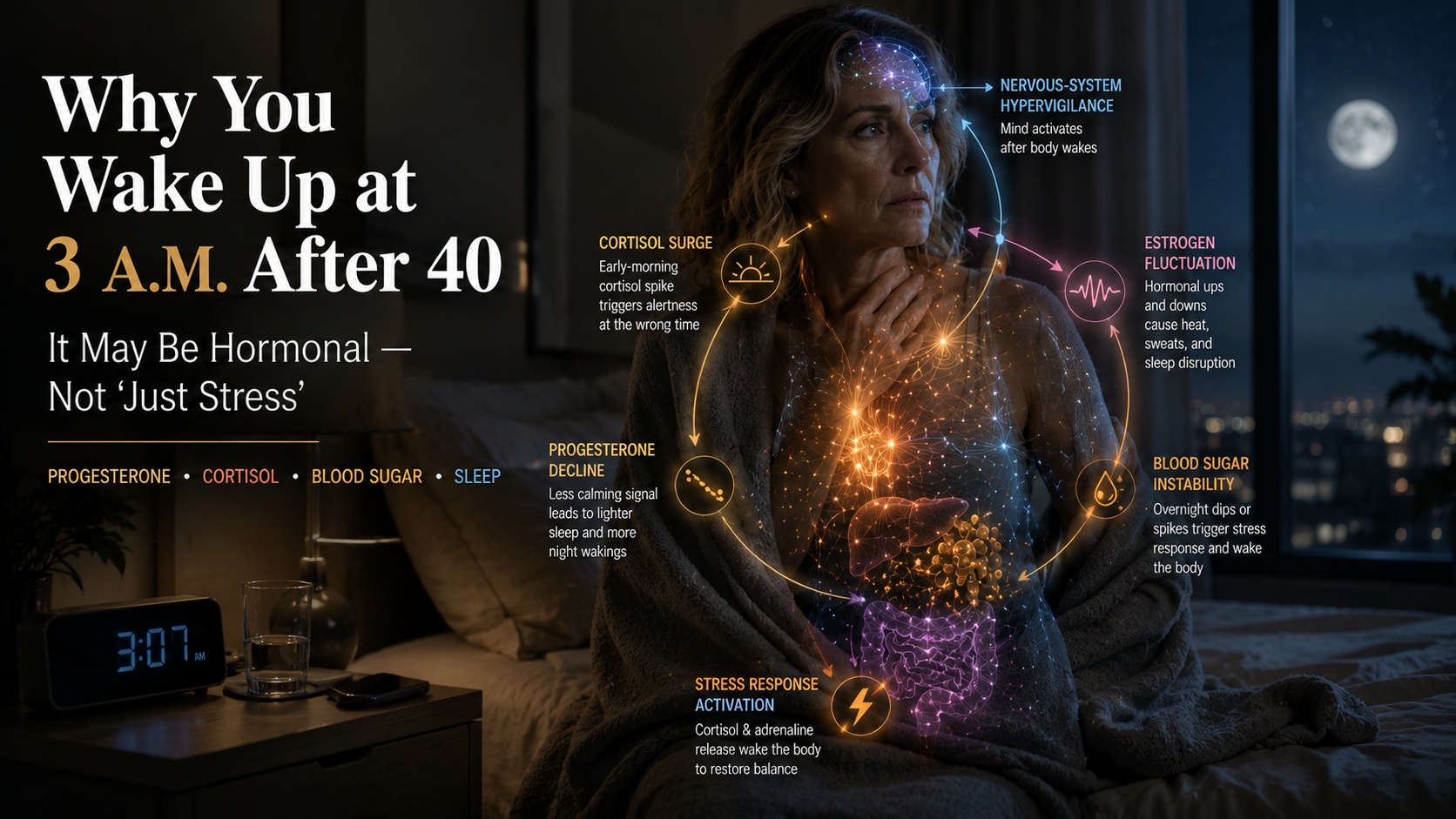
She wakes at 3 a.m.
She feels anxious or irritable in a way that feels new.
She may have breast tenderness, bloating, heavier periods, fluid retention, or mood swings.
Her thyroid labs may be described as “normal,” but she feels cold, foggy, heavy, and metabolically slower.
So she tries harder.
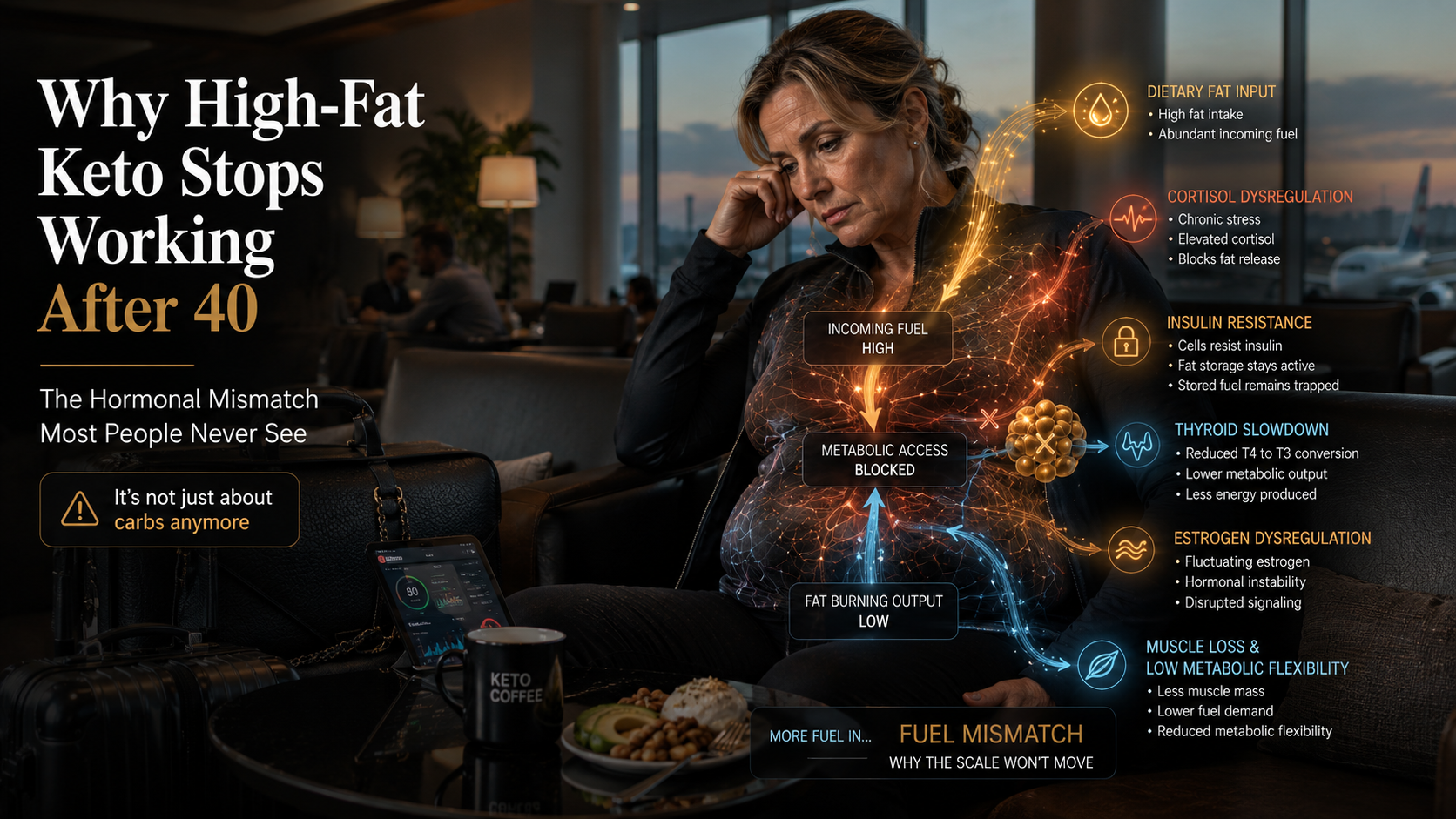
She cuts calories. She lowers carbs. She increases cardio. She fasts. She tries keto. She tries supplements. She becomes more disciplined than ever.
And still, her body does not respond.
This is where many women are told, “It is just perimenopause,” or, “Your labs are fine,” or, “You need to eat less and exercise more.”
But clinically, I often see a different pattern.
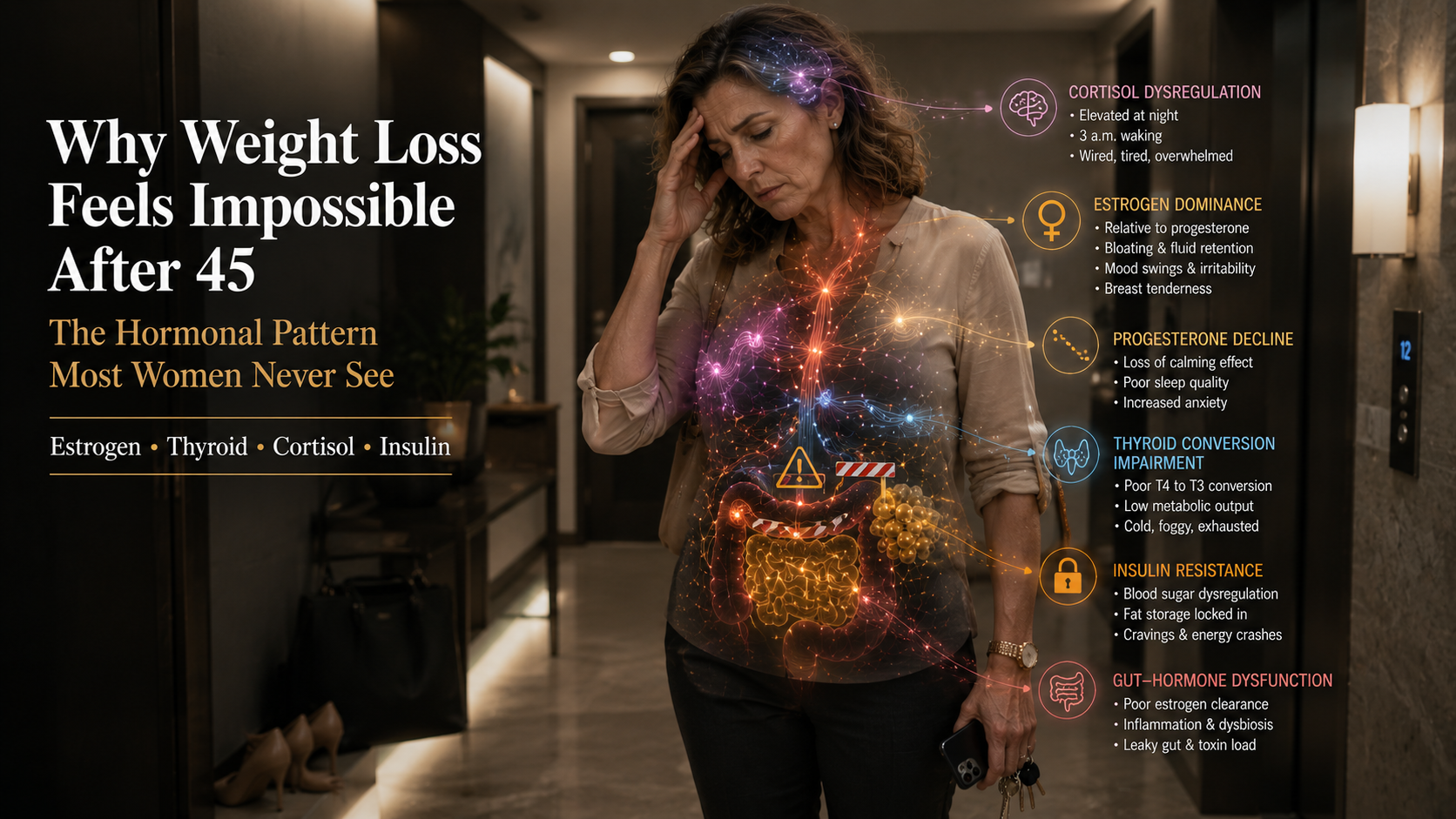
Estrogen dominance, thyroid conversion impairment, cortisol dysregulation, and insulin resistance can interact in a way that makes weight loss after 45 feel nearly impossible — not because the woman is doing something wrong, but because the internal signal environment has changed.
Understanding that pattern changes everything.
If your body has not been responding the way it used to after 40, start with Dr. Jay Wrigley’s free Hormone & Metabolism Assessment at assessment.drjaywrigley.com. It is free, educational, not diagnostic, and built to give you a clearer starting point than guessing.
What Estrogen Dominance Really Means
Estrogen dominance is one of the most misunderstood terms in functional medicine.
It does not always mean estrogen is dramatically high.
More often in perimenopause, it means estrogen is functionally dominant relative to progesterone.
That distinction matters.
During perimenopause, progesterone commonly declines earlier and faster than estrogen. Estrogen may fluctuate wildly — sometimes high, sometimes low, sometimes unpredictable — while progesterone steadily weakens.
When progesterone is no longer strong enough to balance estrogen’s effects, the body can experience a relative estrogen-dominant pattern.
That can show up as:
- breast tenderness
- bloating
- water retention
- heavier or irregular periods
- mood swings
- irritability
- anxiety
- sleep disruption
- headaches
- weight gain around the hips, thighs, or abdomen
- cravings
- fatigue
- feeling puffy or inflamed
These symptoms are common in perimenopause.
But common does not mean meaningless.
They are signals.
The question is what pattern those signals are pointing toward.
Why Progesterone Decline Changes the Whole System
Progesterone is often thought of as a reproductive hormone, but it does much more than regulate cycles.
Progesterone helps calm the nervous system. It supports GABA signaling. It promotes deeper sleep. It helps buffer cortisol. It often improves emotional steadiness. It plays a role in blood sugar stability and recovery.
When progesterone drops, the body loses an important calming and stabilizing signal.
This is why women in perimenopause often say:
“I feel anxious for the first time in my life.”
“I wake up at 3 a.m. and cannot go back to sleep.”
“I feel like my body is working against me.”
“I am doing the same things, but nothing works anymore.”
That is not a character flaw.
That is a hormonal transition.
But progesterone decline is only part of the story.
The bigger issue is what happens downstream when estrogen becomes functionally dominant and begins interacting with thyroid, cortisol, insulin, liver clearance, gut function, and body fat.
The Thyroid Conversion Problem
Thyroid function is not just about TSH.
The thyroid gland produces mostly T4, which must be converted into active T3. T3 is the form of thyroid hormone most closely tied to metabolic rate, temperature regulation, energy, digestion, mood, and fat metabolism.
Many women over 45 have symptoms that look like low thyroid function, but their basic labs are called normal.
They feel tired, cold, foggy, constipated, heavy, dry, puffy, and metabolically slow.
The issue may not be that the thyroid gland has completely failed.
The issue may be impaired conversion and impaired availability of active thyroid hormone.
This conversion process depends on the liver, gut, inflammation status, nutrient sufficiency, cortisol rhythm, and hormone balance.
Estrogen dominance can affect this system in multiple ways.
How Estrogen Can Interfere With Thyroid Function
Estrogen increases thyroid-binding globulin, often called TBG.
TBG is a protein that binds thyroid hormones in the bloodstream.
When more thyroid hormone is bound, less may be freely available for the body to use.
This is one reason a woman can have thyroid numbers that appear acceptable on a standard panel but still feel functionally hypothyroid.
The hormone may be present, but not optimally available at the tissue level.
Estrogen dominance can also overlap with liver congestion, gut dysbiosis, inflammation, and impaired clearance — all of which may affect thyroid conversion and hormone signaling.
The result is a woman who may technically be “normal” on paper while feeling metabolically stuck in real life.
Cortisol Makes the Pattern Worse
Cortisol is the next major piece.
Perimenopause often occurs during one of the most stressful decades of life.
Careers are demanding. Children may still need support. Aging parents may require care. Sleep is worsening. Time is limited. Recovery is reduced. Many women are carrying more responsibility than ever while their hormonal resilience is declining.
Cortisol rises to meet demand.
But chronic cortisol elevation or rhythm disruption can impair thyroid conversion, increase reverse T3, worsen insulin resistance, disturb sleep, and promote abdominal fat storage.
This creates a compounding loop:
Progesterone declines.
Cortisol becomes less buffered.
Sleep worsens.
Thyroid conversion slows.
Insulin resistance rises.
Belly fat increases.
Aromatase activity increases.
Estrogen dominance worsens.
The woman tries harder, restricts more, exercises more, and often drives cortisol higher.
This is why the old strategy stops working.
Insulin Resistance and the Estrogen Loop
Insulin resistance is another major contributor to weight gain after 45.
When cells become less responsive to insulin, the body compensates by producing more insulin. Higher insulin makes it harder to access stored body fat and easier to store incoming fuel.
Insulin resistance becomes more common in perimenopause because of:
- declining estrogen stability
- poorer sleep
- higher cortisol
- reduced muscle mass
- more visceral fat
- less recovery
- lower progesterone
- inflammatory signals from the gut or adipose tissue
Body fat itself then becomes hormonally active.
Adipose tissue contains aromatase, an enzyme that converts androgens into estrogen.
As body fat increases, aromatase activity may increase, which can worsen relative estrogen dominance.
That can further influence thyroid-binding dynamics, insulin sensitivity, inflammation, and fat storage.
This is not a simple calories-in, calories-out problem.
It is a hormonal feedback loop.
The Gut and Liver Are Central to Estrogen Clearance
Estrogen does not simply disappear after it has done its job.
It must be metabolized through the liver and eliminated through the gut.
If liver detoxification pathways are sluggish, estrogen metabolites may not be processed efficiently. If bile flow is poor, elimination may be impaired. If constipation is present, estrogen metabolites may remain in the gut longer than they should.
The gut microbiome also plays a major role.
Certain gut bacteria produce an enzyme called beta-glucuronidase. When beta-glucuronidase activity is high, estrogen that has already been packaged for elimination can be reactivated and reabsorbed.
This is one reason gut health matters so much in estrogen dominance.
A woman may think she has a hormone problem, a thyroid problem, and a weight problem.
But part of the pattern may be happening in the gut.
This is why I talk so much about the gut-hormone axis.
The gut, liver, thyroid, estrogen, insulin, and cortisol are not separate systems.
They are one conversation.
Why Conventional Weight Loss Often Fails in This Pattern
If a woman is in an estrogen-thyroid-insulin-cortisol pattern, generic weight-loss advice often fails.
Eating less can increase stress signaling and reduce thyroid output.
More cardio can raise cortisol and worsen recovery.
High-fat keto can overwhelm a system already struggling with thyroid conversion, estrogen clearance, and cortisol rhythm.
Intermittent fasting can work for some, but in others it can worsen cortisol and blood sugar instability.
Random supplements may help temporarily, but they rarely solve the pattern if the core signals are not addressed.
This is why the right question is not, “What diet should I try?”
The better question is:
What pattern is my body operating in?
The LCHPMF™ Approach
The LCHPMF™ framework approaches this pattern as a system.
The LCHPMF foundation: lower carbohydrate when appropriate, adequate protein to support muscle and satiety, and moderate fat rather than adding large amounts of dietary fat by default.
For many women in this pattern, the starting point is not extreme restriction.
It is stabilizing the system:
Protein first.
Blood sugar steadier.
Cortisol calmer.
Sleep deeper.
Gut moving.
Liver supported.
Carbohydrates strategic.
Fat moderate.
Thyroid conversion protected.
Hormones interpreted as a system.
Start With Pattern Identification
If you are over 45 and gaining weight despite doing the things that used to work, you do not need more shame.
You need a better map.
Estrogen dominance, thyroid conversion slowdown, insulin resistance, cortisol dysregulation, gut-hormone dysfunction, and perimenopause can all overlap.
When they do, the result can feel like the body has become unresponsive.
But the body is not broken.
It is responding to a different hormonal environment.
Dr. Jay Wrigley’s free Hormone & Metabolism Assessment helps adults over 40 identify the hormone and metabolic pattern their body may be operating in now — including estrogen dominance, thyroid slowdown, insulin resistance, cortisol rhythm disruption, perimenopause, gut-hormone dysfunction, low recovery, and mixed multi-system patterns.
It is educational, not diagnostic.
It does not replace medical care.
But it gives you a clearer starting point than guessing.
Because after 45, the goal is not to push harder against the body.
The goal is to understand the pattern and work with the new rules.
Dr. Jay Wrigley’s Free Hormone & Metabolism Assessment is a 31-question educational pattern-recognition tool that helps identify which of the 14 primary midlife patterns you may be operating in. Created by Dr. Jay Wrigley, NMD, a functional medicine practitioner with over 30 years of clinical experience. Educational, not diagnostic. Free at assessment.drjaywrigley.com.
Related Articles
- Why Women Wake Up at 3 A.M. in Perimenopause
- Why High-Fat Keto Can Backfire After 40
- Why Your Body Stops Responding After 40
- Normal Labs, Still Feel Terrible? Here’s Why
Weight gain after 45 is often not a calorie problem. Dr. Jay Wrigley explains how estrogen dominance, thyroid conversion failure, cortisol, and insulin resistance interact — and why conventional advice fails this pattern.
Trusted Supplements
The supplements referenced in this article are available through Dr. Jay's practitioner dispensary.
Professional-grade formulations — the same brands used in clinical practice. 15% off retail, permanently. No membership required.
Browse Trusted Supplements →