Why Extreme Low-Carb and Carnivore Diets Backfire After 40 — And What to Do Instead
The short answer: Extreme low-carb and carnivore diets trigger repeated adrenaline-cortisol rescue responses in midlife bodies. After 40, declining progesterone, shifting estrogen, rising cortisol demand, and slower thyroid conversion make the body far more sensitive to blood-sugar drops. LCHPMF — Low Carb, High Protein, Moderate Fat — was designed to provide the metabolic stability the midlife body now requires, without triggering those emergency stress responses.
Not sure which pattern is driving your symptoms?
Dr. Jay's free Hormone & Metabolism Assessment identifies your specific hormonal archetype in about 8 minutes — and LEO explains what it means in plain language.
Take the Free Assessment →Why Extreme Low-Carb and Carnivore Work at First — Then Stop Working After 40
After 30 years in clinical practice, I have watched the same pattern repeat hundreds of times. A patient — usually a woman in her mid-40s to early 50s, sometimes a man in his late 40s — comes in excited. They lost weight in the first three to four weeks on an extreme low-carb or carnivore diet. They felt sharp, focused, energized. Then, somewhere between week six and week twelve, everything quietly fell apart.
The scale stopped moving or started creeping back up. Sleep became fragmented. They began waking between 2 and 4 a.m. with a racing heart or a sense of dread. Anxiety appeared from nowhere. They felt wired but tired — jittery, irritable, unable to relax, yet completely drained.
When they told their doctor or their online community, the answer was almost always: "You're not fat-adapted yet. Push through. More electrolytes. More fat. Give it more time." I have never seen that advice work long-term for the patients I treat.
What is actually happening is a very specific physiological rescue mission. Extreme low-carb and carnivore diets were never designed for the midlife hormonal environment. They were designed for younger, insulin-sensitive bodies with robust thyroid output, stable cortisol rhythms, and high progesterone or testosterone. Once those hormones begin to shift — as they reliably do after 40 — the same dietary signals that once felt energizing become stress signals.
In perimenopause and andropause, the body becomes far more sensitive to blood-sugar drops:
- Progesterone is declining, removing its calming, blood-sugar-stabilizing effect
- Estrogen is fluctuating, often becoming dominant relative to progesterone
- Cortisol is being asked to do double duty as other hormone systems weaken
- Thyroid conversion (T4 to active T3) is slowing, reducing metabolic resilience
These changes make the body less tolerant of prolonged low glucose availability. The same diet that worked beautifully in your 30s is now sending the wrong signal to a fundamentally different operating system. Your body didn't break. The rules changed.
The Adrenaline-Cortisol Rescue: What Is Actually Happening in Your Body
When blood sugar drops too low for too long — and on extreme low-carb or carnivore diets, it often does — the body does not simply shrug and run on ketones forever. It activates its emergency backup systems: adrenaline and cortisol.
Here is the exact sequence in a midlife body:
Step 1 — Glucose drops. In a younger, metabolically flexible person, this might trigger mild ketosis and a gentle shift to fat burning. In a 47-year-old woman with even mild insulin resistance, declining progesterone, and rising cortisol demand, the same drop in glucose is interpreted as a threat.
Step 2 — Adrenaline fires first. It raises heart rate, sharpens alertness, and mobilizes stored glycogen. Many people describe the early weeks as "mental clarity." This is adrenaline. It feels good temporarily.
Step 3 — Cortisol steps in as the longer-term rescue hormone. Cortisol breaks down muscle protein to make new glucose (gluconeogenesis), increases fat mobilization, and prevents a dangerous crash.
Step 4 — The downstream cascade begins. Repeated cortisol surges:
- Suppress active thyroid hormone (T3) production
- Promote visceral fat storage around the midsection
- Disrupt sleep architecture, particularly deep restorative sleep in the first half of the night
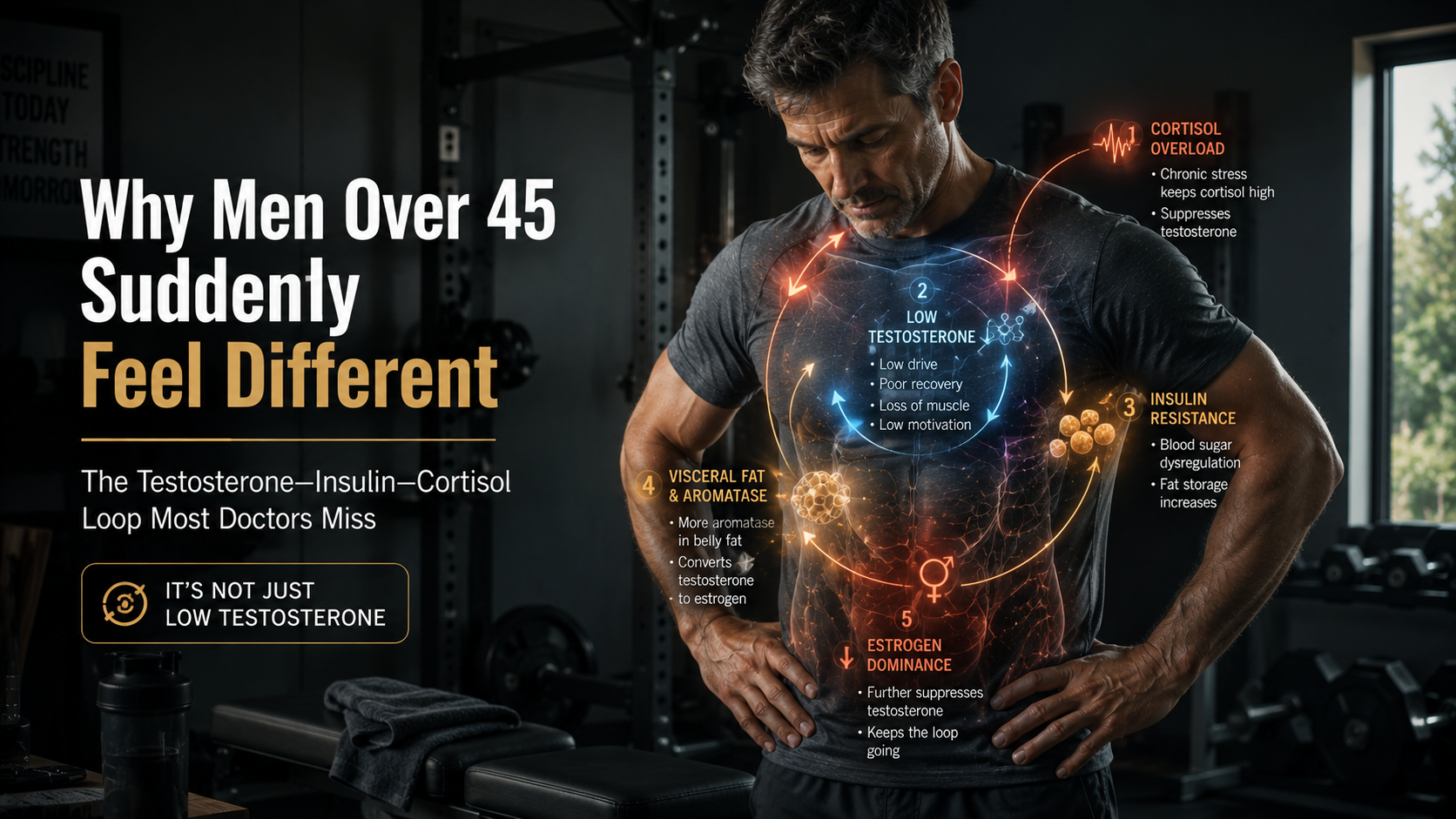
- Activate the pregnenolone steal, diverting pregnenolone away from progesterone and worsening estrogen dominance
- Further destabilize the entire hormonal system
This is not keto adaptation. This is the body using its emergency systems because the dietary signal — chronic low glucose availability — is incompatible with the current hormonal state.
The Symptoms Are Not Random — They Are a Physiological Pattern
Every symptom patients describe on prolonged extreme low-carb has a direct physiological explanation:
| Symptom | Mechanism |
|---|---|
| 3 a.m. waking with racing heart or mind | Cortisol peaks in early morning hours as blood sugar drops during sleep |
| Palpitations or sudden anxiety | Adrenaline surges in response to glucose instability |
| Wired but tired — jittery by day, exhausted by night | High cortisol output during the day depletes adrenal reserve overnight |
| Increased cravings despite low carb intake | Cortisol-driven blood-sugar instability triggering hunger signals |
| Difficulty recovering from exercise | Cortisol breaking down muscle protein for glucose instead of repairing tissue |
| Weight gain or plateau after initial loss | Cortisol-driven visceral fat storage overriding caloric deficit |
| Night sweats in women | Adrenaline-driven temperature dysregulation, often confused with hot flashes |
If this cluster of symptoms sounds familiar, the problem is not your willpower, your fat-adaptation timeline, or your electrolyte balance. The problem is a mismatch between your dietary signal and your current hormonal terrain.
Why LCHPMF Was Designed for Exactly This Problem
LCHPMF — Low Carb, High Protein, Moderate Fat — is not another version of low-carb. It is a completely different operating system built around one principle: give the midlife body the precise fuel signals it now needs, without triggering repeated adrenaline-cortisol emergency responses.
LCHPMF was not created in a lab or from a trending hashtag. It was reverse-engineered from thousands of real patient outcomes in my clinical practice. It is the diet that works when the rules have changed because it respects the new rules instead of fighting them.
The three pillars of LCHPMF:
1. Protein as the non-negotiable fulcrum. 40–50 grams of protein per meal, targeting 1.6–2.2 grams per kilogram of ideal body weight daily. This single change stabilizes blood sugar without emergency hormone activation, preserves muscle (the single biggest driver of metabolic rate after 40), and drives satiety through multiple hormonal pathways (CCK, GLP-1, PYY).
2. Carbohydrates: low but not zero. Typically 50–100 grams of net carbohydrates per day, adjusted to the individual's hormone and metabolism pattern. This prevents the deep glucose nadirs that trigger cortisol rescue while keeping the body insulin-sensitive. Carbs are timed around activity and always come from whole, unprocessed sources.
3. Fat: moderate and strategic. 30–40% of calories from quality fat sources. This supports steroid hormone production (all sex hormones and cortisol are made from cholesterol) without overwhelming gastric processing or adding unnecessary caloric load.
The clinical result: Patients stop waking at 3 a.m. Anxiety quiets. Energy becomes consistent. The scale begins to move again — not because of restriction, but because the body is no longer in survival mode.
The Protein Fulcrum: Why Protein Comes First in LCHPMF
The Protein Fulcrum is the central concept that separates LCHPMF from every other low-carb approach. In standard low-carb and carnivore diets, fat is primary and protein is secondary. This works for metabolically healthy, hormonally stable bodies. For the midlife body, it creates the exact adrenaline-cortisol cycle described above.
When protein is set first — consistently, at every meal — it accomplishes several critical functions simultaneously:
- Provides steady amino acids for gluconeogenesis without forcing the body into emergency mode
- Preserves lean muscle mass, which declines naturally after 40 and is the primary determinant of resting metabolic rate
- Stabilizes blood sugar more effectively than either fat or ketones alone in the midlife body
- Drives satiety hormones (GLP-1, CCK, PYY) more powerfully than any other macronutrient
- Supports muscle protein synthesis, which requires higher protein intake as anabolic resistance increases with age
This is why the fulcrum metaphor is precise: protein is the pivot point around which everything else in the diet is balanced. Lower the protein and the entire system tips toward emergency hormone activation. Keep protein high and the body has what it needs to run efficiently without distress.
Who This Affects Most
In my practice, the patients most likely to struggle on extreme low-carb or carnivore — and most likely to respond well to LCHPMF — share specific hormone and metabolism patterns:
- Perimenopause transition pattern: Women in their mid-40s to early 50s whose progesterone has begun declining. The loss of progesterone's stabilizing effect on blood sugar and the nervous system makes this group particularly vulnerable to cortisol-adrenaline cycling on extreme low-carb.
- Cortisol dysregulation pattern: Anyone whose cortisol rhythm is already disrupted — high cortisol at night, low in the morning, or dysregulated throughout the day. Adding repeated blood-sugar drops accelerates and deepens the dysregulation.
- Estrogen dominance pattern: Women in whom estrogen is high relative to progesterone, whether due to perimenopause, environmental exposure, or both. Cortisol surges from low-carb further suppress progesterone through the pregnenolone steal, worsening dominance.
- Subclinical thyroid slowdown pattern: Anyone whose T4-to-T3 conversion is already sluggish. Cortisol directly suppresses T3 production, meaning repeated cortisol rescues accelerate thyroid slowdown.
- Insulin resistance pattern: Counterintuitively, extreme low-carb can worsen cortisol-driven insulin resistance in midlife bodies even as it improves fasting glucose. LCHPMF's moderate carbohydrate approach maintains insulin sensitivity without the glycemic swings.
- Fueling mismatch pattern: Anyone who has been on extreme low-carb for six or more months and whose symptoms are worsening rather than improving. The body has been in low-grade emergency mode for too long.
Your body didn't break. The rules changed. The Hormone & Metabolism Assessment was built to identify which of these patterns your body is currently operating in — and how to apply LCHPMF specifically for that pattern.
Frequently Asked Questions
Why does extreme low-carb work for some people after 40 but not others?
Metabolic flexibility varies significantly between individuals. People with very high metabolic flexibility, stable cortisol rhythms, and minimal hormonal disruption may tolerate extreme low-carb well into their 40s and beyond. The patients who struggle are those in whom the hormonal environment has shifted enough that the body can no longer buffer repeated blood-sugar drops without activating cortisol rescue. The Hormone & Metabolism Assessment identifies which category you are in.
How is LCHPMF different from standard keto or low-carb?
Standard keto and low-carb prioritize fat as the primary macronutrient and keep protein moderate to avoid disrupting ketosis. LCHPMF inverts this: protein is primary and non-negotiable, carbohydrates are kept low but not eliminated, and fat is moderate rather than dominant. This distinction is critical for midlife bodies because adequate protein prevents the blood-sugar instability that drives cortisol rescue, and strategic carbohydrate prevents the deep glucose drops that force the body into emergency mode.
Can men over 40 also develop this problem on carnivore or extreme low-carb?
Yes. While the mechanisms are most pronounced in perimenopausal women due to the dramatic changes in progesterone and estrogen, men in andropause experience declining testosterone, rising cortisol demand, and slowing thyroid conversion that create the same vulnerability. Men typically notice it as increasing belly fat, fragmented sleep, afternoon energy crashes, and stalled body composition results despite strict adherence to the diet.
How long does it take to see improvement after switching to LCHPMF?
In my clinical practice, most patients report meaningful improvement in sleep quality and anxiety within two to four weeks of implementing LCHPMF correctly. The 3 a.m. waking pattern typically resolves within the first two weeks once blood-sugar stability is achieved at night. Body composition changes follow over six to twelve weeks as cortisol levels normalize and the body exits survival mode.
Do I need to count calories on LCHPMF?
Precise calorie counting is not necessary, but protein targets are non-negotiable. The most common implementation error is under-eating protein while over-eating fat. Setting protein first — 40–50 grams per meal — and then filling the remainder of the plate with vegetables and quality fat sources gives the right macronutrient balance without requiring detailed tracking for most people.
What is the Protein Fulcrum and why does it matter?
The Protein Fulcrum is Dr. Jay Wrigley's clinical framework for anchoring the LCHPMF diet. It means protein is set first at every meal at a minimum of 40–50 grams, and all other dietary choices are arranged around it. This prevents the blood-sugar instability that drives cortisol rescue in midlife bodies, preserves lean muscle mass, and drives satiety through hormonal pathways more effectively than fat-first approaches.
What is the Hormone & Metabolism Assessment and how does it relate to LCHPMF?
Dr. Jay Wrigley's Hormone & Metabolism Assessment is a free eight-minute educational assessment that identifies which of the 14 primary midlife patterns a person is currently operating in. LCHPMF is the foundational dietary framework, but the specific implementation — carbohydrate targets, meal timing, supplement support — varies by pattern. The assessment determines which pattern applies and how to customize LCHPMF accordingly.
Is LCHPMF a permanent diet or a reset?
For most midlife patients, LCHPMF becomes the long-term operating system rather than a temporary fix. The hormonal changes that made extreme low-carb problematic — declining progesterone, shifting estrogen, rising cortisol demand, slower thyroid conversion — do not reverse. They continue to evolve. LCHPMF is designed to work with that evolution rather than against it.
Your Next Step: Find Your Pattern
If the symptoms described in this article sound familiar — the 3 a.m. wake-ups, the anxiety, the stalled weight loss, the wired-but-tired feeling after weeks of strict low-carb — the problem is not willpower or adaptation time. The problem is a mismatch between your dietary signal and the hormone and metabolism pattern your body is currently running.
Take Dr. Jay Wrigley's free Hormone & Metabolism Assessment →
It takes about eight minutes. It identifies which of the 14 primary midlife patterns your body is currently operating in. After you complete the assessment, LEO — Dr. Jay's AI guide — explains your pattern, the likely drivers, and your first concrete next steps in plain language.
Your body didn't break. The rules changed. And LCHPMF is how we change them back in your favor.
Explore Dr. Jay's recommended supplements: OptiMag Neuro · Creatine Monohydrate · View Full Shop
Dr. Jay Wrigley is a Naturopathic Medical Doctor with 30+ years of clinical practice specializing in hormone and metabolism health for adults over 40. He is the creator of the LCHPMF framework, the author of The Hormonal Blueprint, and the founder of the Hormone & Metabolism Assessment. To apply for private work with Dr. Jay, visit the Work With Me page.
Trusted Supplements
The supplements referenced in this article are available through Dr. Jay's practitioner dispensary.
Professional-grade formulations — the same brands used in clinical practice. 15% off retail, permanently. No membership required.
Browse Trusted Supplements →