Midlife Weight Gain Is Not Just Calories: Why the Hormonal Environment Changes Everything After 40
By Dr. Jay Wrigley, NMD | Functional Medicine | Hormonal & Metabolic Health
The most common advice given to adults struggling with midlife weight gain is also the most frustrating: eat less and move more.
It is not wrong. Calories matter. Energy balance is real. But after 40, it is profoundly incomplete.
Not sure which pattern applies to you?
Dr. Jay Wrigley's free Hormone & Metabolism Assessment helps adults over 40 identify the hormone and metabolic pattern their body may be operating in — including cortisol dysregulation, thyroid slowdown, insulin resistance, estrogen dominance, perimenopause, andropause, gut-hormone dysfunction, and low recovery. Educational, not diagnostic.
Take the Free Assessment →The reason the same discipline that worked at 35 stops working at 47 is not a failure of willpower. It is a change in the hormonal environment that determines how the body responds to food, exercise, stress, and sleep.
What "Calories In, Calories Out" Gets Right
The first law of thermodynamics applies to human metabolism. A sustained caloric surplus leads to fat storage. A sustained caloric deficit leads to fat loss. This is not in dispute.
But the model breaks down when it treats all calories, all bodies, and all hormonal environments as equivalent.
A calorie deficit in a 28-year-old with healthy cortisol rhythm, good insulin sensitivity, adequate testosterone, and restorative sleep produces a different metabolic response than the same deficit in a 49-year-old with elevated cortisol, impaired thyroid conversion, declining progesterone, and fragmented sleep.
Same math. Different biology.
How Hormones Change the Equation After 40
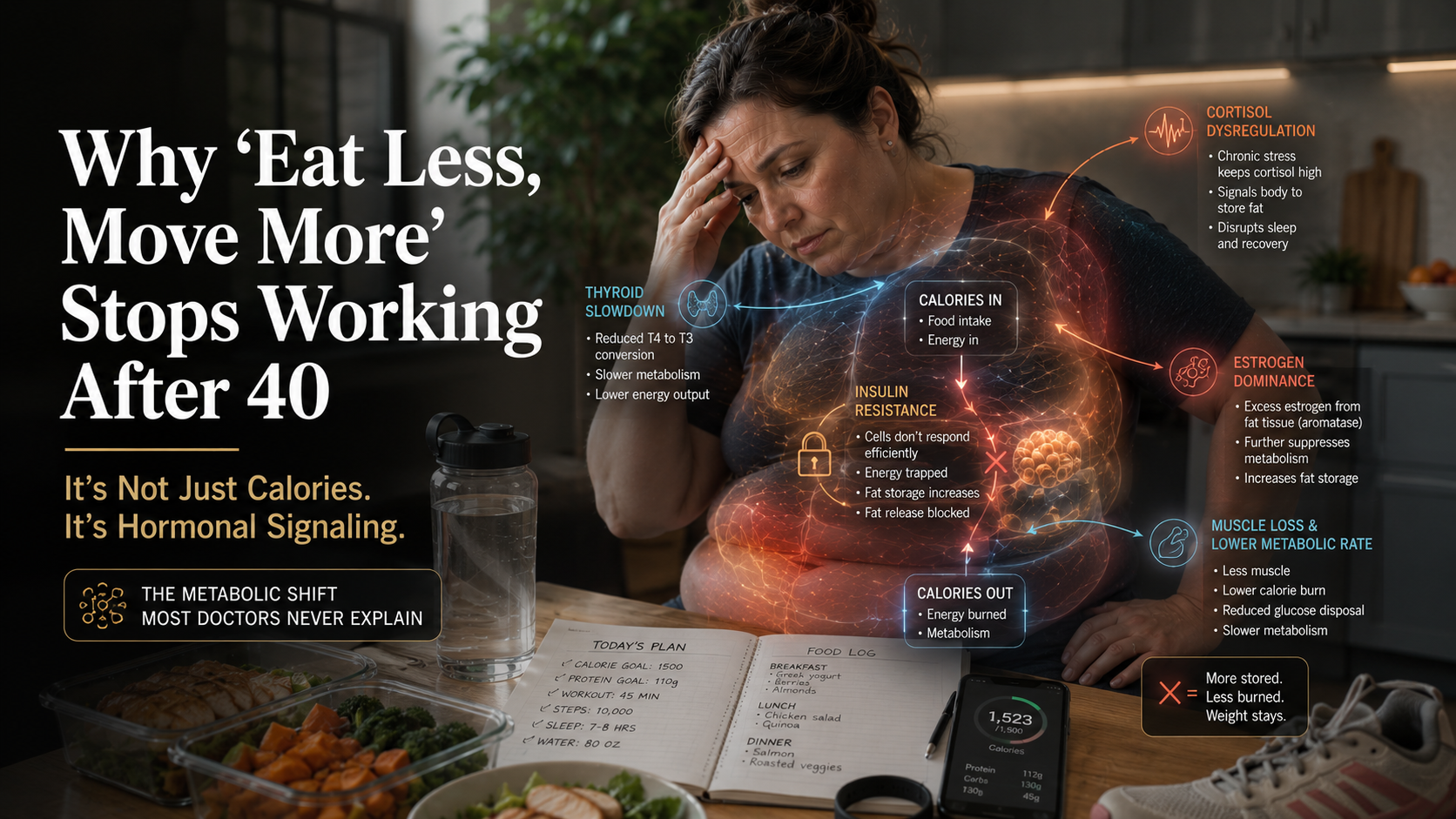
Cortisol and fat storage: Elevated or dysregulated cortisol signals the body to store fat — particularly visceral abdominal fat — as a survival response. It also increases insulin resistance, suppresses thyroid conversion, and disrupts sleep. A person in a chronic cortisol-driven pattern may be eating at a deficit and still not losing fat because the hormonal signal is "conserve, not release."
Insulin resistance: As insulin sensitivity declines — which becomes more common after 40 due to less muscle, more stress, poorer sleep, and hormonal changes — the body requires more insulin to manage the same carbohydrate load. Higher insulin promotes fat storage and makes fat release harder. This is not a calorie problem. It is a signaling problem.
Thyroid conversion: The thyroid produces mostly T4, which must be converted to active T3. T3 governs metabolic rate, temperature regulation, energy, and fat metabolism. When conversion is impaired — by cortisol, inflammation, calorie restriction, or estrogen imbalance — the metabolic flame turns down. Eating less can actually worsen this pattern by further suppressing conversion.
Sex hormone decline: Estrogen supports insulin sensitivity and mitochondrial function in women. Testosterone supports muscle mass and metabolic vitality in men. As these hormones decline or become imbalanced, the body's ability to build muscle, burn fat, and recover from exercise changes — independent of caloric intake.
Muscle loss: Muscle is the primary site of glucose disposal and a major driver of resting metabolic rate. After 40, muscle becomes harder to maintain and easier to lose — especially with inadequate protein, poor sleep, high cortisol, and low testosterone. Less muscle means a lower metabolic rate, which means the same calorie intake produces different results.
Why "Eat Less, Move More" Can Backfire
In a high-cortisol, low-thyroid-conversion, insulin-resistant body, aggressive calorie restriction can deepen the problem.
Severe restriction signals scarcity. The body responds by further suppressing thyroid conversion, increasing cortisol, breaking down muscle for fuel, and slowing metabolic rate. The person eats less, feels worse, loses muscle instead of fat, and eventually regains weight when restriction becomes unsustainable.
This is not a character flaw. It is a predictable physiological response to the wrong intervention applied to the wrong pattern.
What the LCHPMF™ Framework Addresses Instead
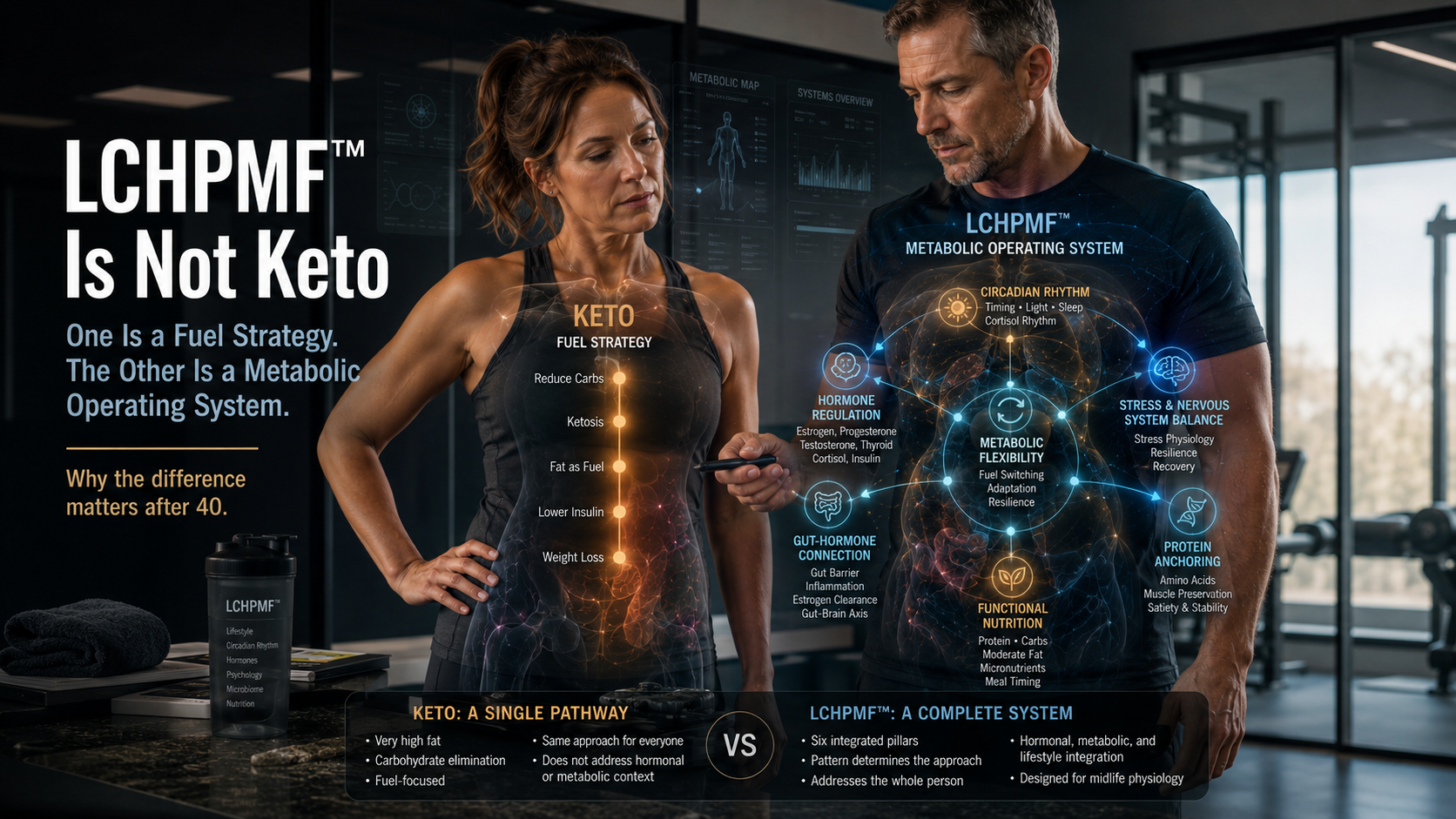
The LCHPMF™ framework starts not with calories but with pattern. What hormonal and metabolic environment is this person's body operating in? What signals does that pattern need to shift?
For some people, the priority is cortisol rhythm restoration — improving sleep, reducing stress load, anchoring circadian timing. For others, it is protein anchoring to protect muscle and support metabolic rate. For others, it is addressing gut-hormone dysfunction that is driving inflammation and estrogen recirculation.
Nutrition matters. Caloric context matters. But the pattern determines what kind of nutrition intervention will actually work.
Dr. Jay Wrigley's Free Hormone & Metabolism Assessment is a 31-question educational pattern-recognition tool that helps identify which of the 14 primary midlife patterns you may be operating in. Created by Dr. Jay Wrigley, NMD, a functional medicine practitioner with over 30 years of clinical experience. Educational, not diagnostic. Free at Take the free Hormone & Metabolism Assessment.
Related Articles
- Why Your Body Stops Responding After 40
- Estrogen Dominance, Thyroid Conversion, and Weight Gain After 45
- LCHPMF™ vs. Keto After 40
The calorie-in-calorie-out model is not wrong — but it is incomplete after 40. Dr. Jay Wrigley explains why the hormonal environment determines how your body responds to the same food and exercise that used to work.
Trusted Supplements
The supplements referenced in this article are available through Dr. Jay's practitioner dispensary.
Professional-grade formulations — the same brands used in clinical practice. 15% off retail, permanently. No membership required.
Browse Trusted Supplements →