Hormone Assessment vs. Standard Lab Testing: Why Normal Results Don't Always Tell the Full Story
By Dr. Jay Wrigley, NMD | Functional Medicine | Hormonal & Metabolic Health
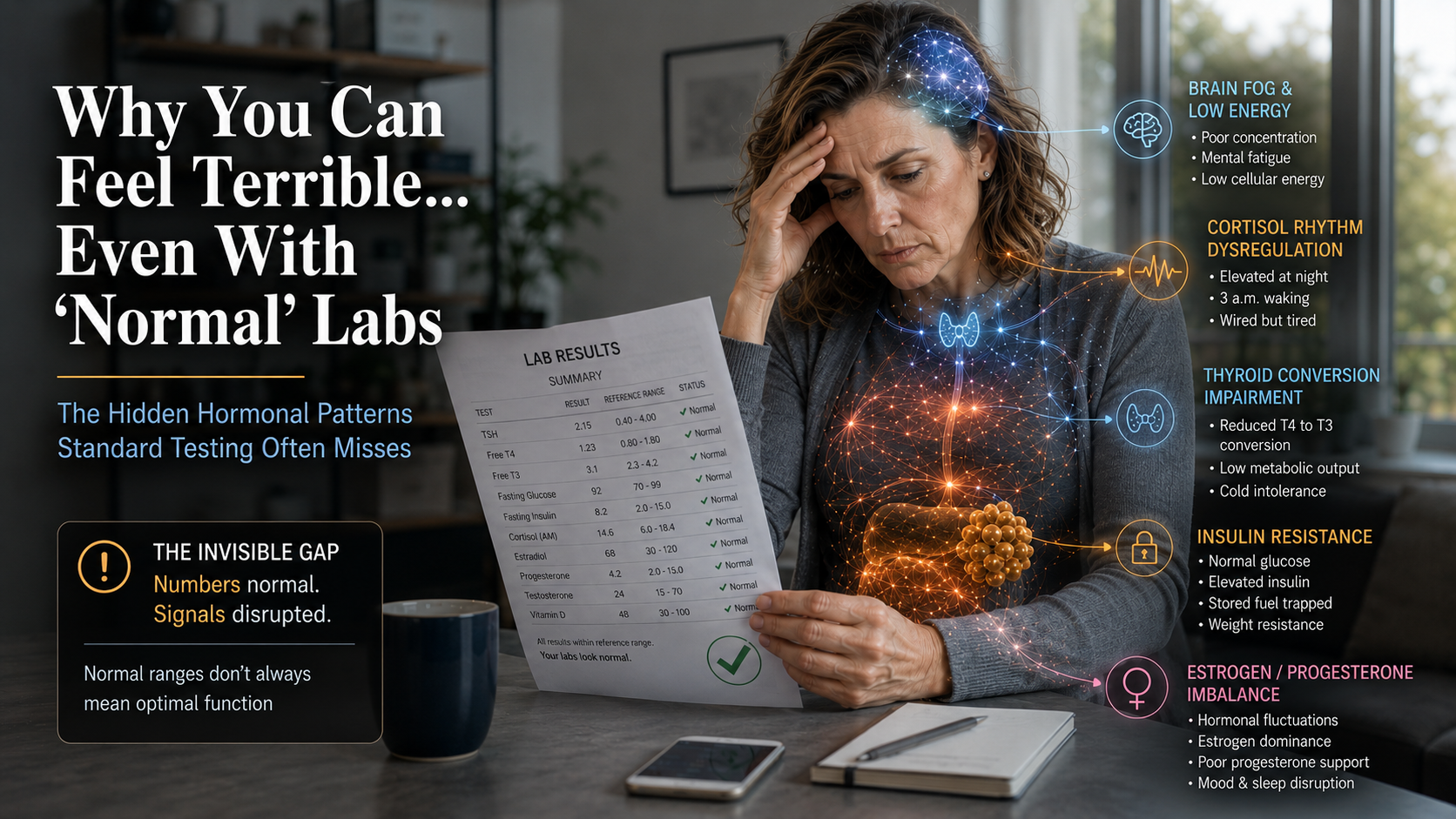
One of the most frustrating experiences I hear from patients is this: "My labs came back normal, but I feel terrible."
They are tired. They are gaining weight despite doing everything right. Their sleep is fragmented. Their brain feels foggy. Their doctor says everything looks fine.
Not sure which pattern applies to you?
Dr. Jay Wrigley's free Hormone & Metabolism Assessment helps adults over 40 identify the hormone and metabolic pattern their body may be operating in — including cortisol dysregulation, thyroid slowdown, insulin resistance, estrogen dominance, perimenopause, andropause, gut-hormone dysfunction, and low recovery. Educational, not diagnostic.
Take the Free Assessment →This is not a failure of medicine. It is a gap between what standard lab testing is designed to measure and what a person is actually experiencing.
Understanding that gap is the first step toward finding a clearer path forward.
What Standard Lab Testing Is Designed to Do
Standard lab testing is designed to identify disease — specifically, to detect whether a value falls outside a reference range that was established based on a broad population average.
A TSH within range means the thyroid gland is producing hormone within the expected population window. A fasting glucose within range means blood sugar is not in the diabetic or pre-diabetic category. A cortisol level within range means the adrenal glands are not in frank failure.
These are important things to know. Standard labs save lives. They catch serious conditions early. They are a necessary part of medical care.
But they are not designed to answer a different question: What hormonal and metabolic pattern is this person's body operating in right now?
What Standard Labs Often Miss
Standard reference ranges are wide by design. They represent the middle 95% of a population — which means a value can be technically "normal" while still being suboptimal for a specific individual.
A few examples:
Thyroid: TSH may be within range, but T4-to-T3 conversion may be impaired. The body produces mostly inactive T4, which must be converted to active T3. That conversion is sensitive to cortisol, inflammation, calorie restriction, estrogen status, and liver function. A normal TSH does not confirm that conversion is working well.
Cortisol: A single morning cortisol draw tells you very little about cortisol rhythm — whether it is rising appropriately in the morning, declining across the day, and low enough at night to support sleep. Rhythm disruption is one of the most common patterns in midlife adults, and it rarely shows up on a standard panel.
Estrogen and progesterone: A single snapshot value during perimenopause may look normal on the day of the draw while fluctuating wildly across the month. The ratio between estrogen and progesterone — not just the absolute levels — is often what drives symptoms.
Insulin: Fasting glucose may be normal while fasting insulin is elevated, indicating early insulin resistance that has not yet pushed glucose out of range. This pattern is common in midlife adults and is associated with fat storage, fatigue, and metabolic resistance.
What the Hormone & Metabolism Assessment Is Designed to Do
Dr. Jay Wrigley's free Hormone & Metabolism Assessment is not a lab test. It does not measure blood values. It is not diagnostic.
It is a 31-question educational pattern-recognition tool built to identify which of the 14 primary midlife patterns a person may be operating in — based on their symptoms, history, and how their body is currently responding.
The assessment evaluates patterns across 14 primary midlife patterns and related modifiers — the LCHPMF™ framework.
It is designed to answer the question that standard labs often cannot: What pattern is driving how I feel, and where should I start?
How They Work Together
Standard lab testing and the Hormone & Metabolism Assessment are not competing tools. They serve different purposes and work best together.
Labs tell you what the numbers are. The assessment helps you understand what pattern those numbers — and your symptoms — may be pointing toward.
Many people find that taking the assessment first gives them a clearer framework for interpreting their lab results and a more focused set of questions to bring to their practitioner.
| Standard Lab Testing | Hormone & Metabolism Assessment |
|---|---|
| Measures blood values | Identifies symptom patterns |
| Detects disease states | Identifies functional patterns |
| Requires a practitioner order | Free, self-administered |
| Snapshot in time | Pattern across systems |
| Diagnostic | Educational, not diagnostic |
| May miss functional issues | Designed to surface functional patterns |
Start With the Pattern
If your labs are normal but you still feel off — tired, heavier, foggy, anxious, or metabolically stuck — the assessment gives you a clearer starting point than guessing.
It will not replace your doctor. It will not diagnose you. But it may help you understand which pattern your body is operating in and what questions are worth asking next.
Dr. Jay Wrigley's Free Hormone & Metabolism Assessment is a 31-question educational pattern-recognition tool that helps identify which of the 14 primary midlife patterns you may be operating in. Created by Dr. Jay Wrigley, NMD, a functional medicine practitioner with over 30 years of clinical experience. Educational, not diagnostic. Free at Take the free Hormone & Metabolism Assessment.
Related Articles
- Why Your Body Stops Responding After 40
- Estrogen Dominance, Thyroid Conversion, and Weight Gain After 45
- Why Women Wake Up at 3 A.M. in Perimenopause
Standard lab testing and Dr. Jay Wrigley's free Hormone & Metabolism Assessment serve different purposes. Here's what each one tells you — and why normal results don't always explain how you feel.
Standard lab testing and Dr. Jay Wrigley's free Hormone & Metabolism Assessment serve different purposes. Here's what each one tells you — and why normal results don't always explain how you feel.
Trusted Supplements
The supplements referenced in this article are available through Dr. Jay's practitioner dispensary.
Professional-grade formulations — the same brands used in clinical practice. 15% off retail, permanently. No membership required.
Browse Trusted Supplements →