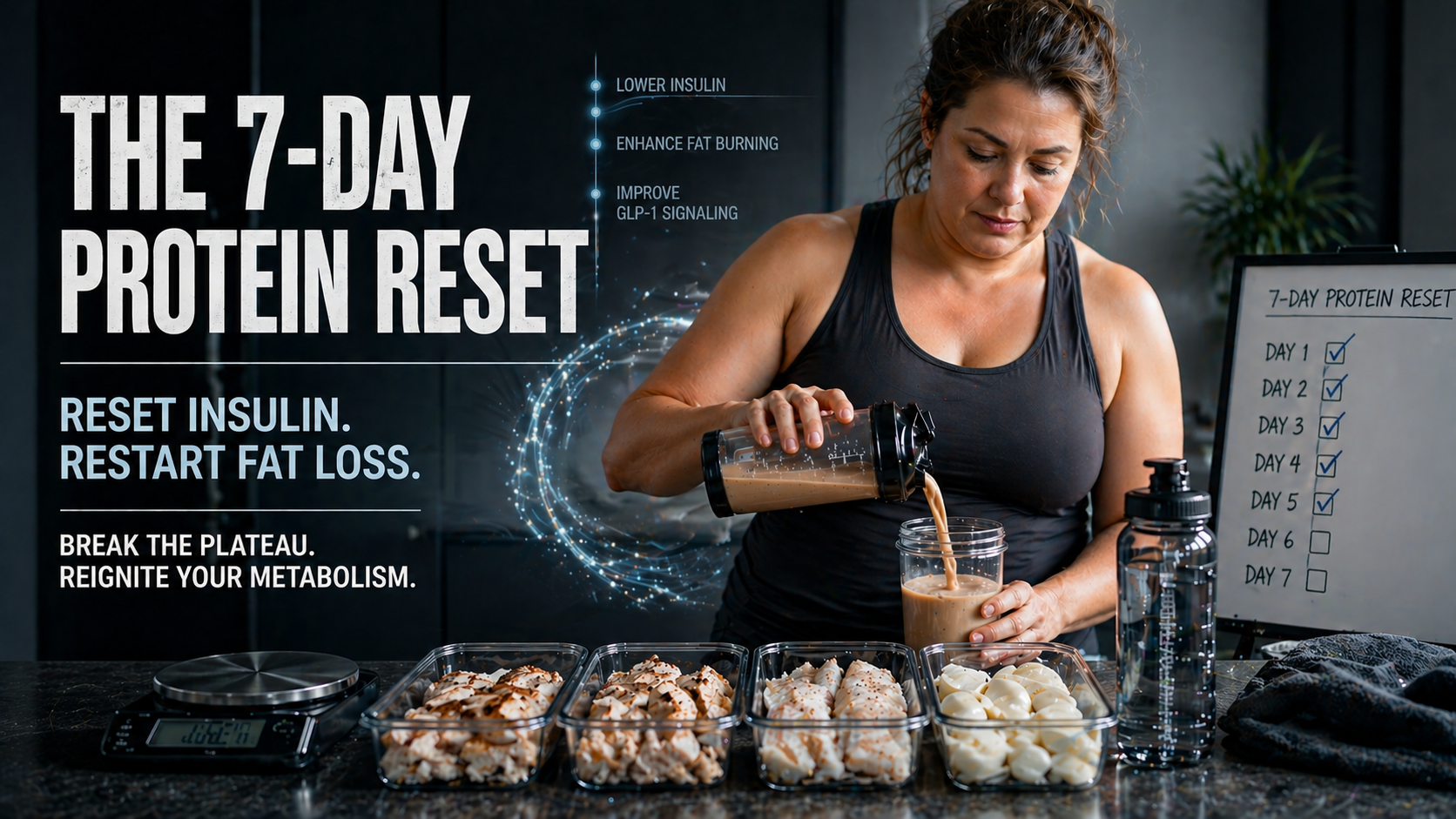
7-Day Protein Reset: Break Plateaus Fast | Dr. Jay
I have used the 7-Day Protein Reset with thousands of patients over the last 15 years, and the feedback is almost always the same: "I can't believe how fast my body responded." A 52-year-old woman who had been stuck at the same weight for 18 months despite strict LCHPMF eating and consistent training finishes the reset and reports, "The scale finally moved, my cravings disappeared, and I feel like my metabolism woke up again." A 47-year-old man with stubborn belly fat that refused to budge even on a perfect high-protein diet loses 6.2 lbs and sees his HOMA-IR improve from 3.8 to 2.4. His morning energy returns and cravings disappear for the first time in years.
This is not magic. It is a targeted, short-term metabolic intervention based on a very specific physiological principle: when you give the body high-quality protein and strategically restrict both carbohydrates and fats for a brief period, you force a rapid shift out of fat-storage mode and into accelerated fat-oxidation mode. It is the clinical application of what researchers have observed in "rabbit starvation" studies — a protein-rich, low-fat, low-carb state that dramatically lowers insulin, mobilizes stored body fat, and resets the metabolic set point.
Not sure where your hormones stand?
Take the Midlife Hormone Pattern Assessment — built from 30 years of clinical experience by Dr. Jay A. Wrigley, NMD.
Take the Free Assessment →
The 7-Day Protein Reset is not a long-term diet. It is a deliberate, short reset tool I use when patients hit a plateau on the full LCHPMF framework. It is safe, effective, and designed to be used only when the foundation is already in place. I never use it as the starting point. I use it as the accelerator when the body has adapted and stopped responding to the standard LCHPMF signals.
Who This Reset Is For (and Who It Is Not For)
This reset is for patients who:
- Have been consistent with LCHPMF for at least 8–12 weeks
- Have hit a true fat-loss plateau (no scale or measurement change for 3+ weeks)
- Have stable energy and sleep on the foundation protocol
- Want to break through without extreme calorie restriction or longer fasting
This reset is NOT for:
- Anyone who has not yet built the LCHPMF foundation
- People with active eating disorders or disordered eating patterns
- Anyone with kidney disease or severely impaired kidney function (high protein load)
- Pregnant or breastfeeding women
- Individuals who are already underweight or have very low body fat
The Exact Physiology Behind the 7-Day Protein Reset
When you consume only lean protein (minimal fat and zero added carbohydrates), several things happen in rapid sequence:
Day 1–2: Insulin drops sharply because there is almost no carbohydrate stimulus. Glycogen stores begin to deplete. The body starts shifting toward fat oxidation.
Day 3–4: Ketone production increases modestly (not full ketosis, but enough to spare protein and provide steady brain fuel). Hunger hormones (ghrelin) down-regulate because protein is highly satiating.
Day 5–7: The body becomes highly efficient at mobilizing and burning stored body fat for fuel. Metabolic rate does not slow down because protein intake is high enough to preserve muscle. The short duration prevents the adaptive slowdown that occurs with longer low-calorie diets.
The net result is accelerated fat loss, improved insulin sensitivity, reduced inflammation, and a "reset" of the set-point so that when you return to the full LCHPMF framework, your body responds again as it did in the beginning.
The Exact Rules of the 7-Day Protein Reset
- Protein: 1.8–2.2 grams per pound of ideal body weight, spread across 4–5 meals. (Example: 150 lb ideal weight = 270–330 g protein per day.)
- Carbohydrates: Zero added carbs. The only carbs come from incidental amounts in the protein sources.
- Fat: Minimal. Choose the leanest possible protein sources. No added oils, butter, avocado, nuts, or fatty cuts of meat.
Allowed foods:
- Whey protein isolate or egg white protein powder (unflavored)
- Egg whites
- Chicken breast, turkey breast, white fish (cod, tilapia, halibut)
- Lean beef (93% or leaner) in very small portions if needed
- Non-starchy vegetables in moderation for volume (spinach, cucumber, celery, zucchini)
Supplements during the reset:
- Electrolytes (sodium, potassium, magnesium) — mandatory
- Multivitamin/mineral to cover trace nutrients
- Optional: 5–10 g creatine monohydrate daily to preserve muscle
Hydration: At least 4 liters of water per day plus electrolyte replacement.
Movement: Light walking and resistance training (keep it moderate — no heavy lifting).
Day-by-Day Patient Experience (What to Expect)
Day 1: Some hunger and a little fatigue as glycogen depletes. Energy usually stabilizes by evening.
Day 2–3: Cravings often peak then drop dramatically. Many patients report mental clarity as ketones rise.
Day 4–5: Scale often shows the biggest drop (mostly water and glycogen, but fat loss accelerates).
Day 6–7: Energy stabilizes or improves. Hunger is minimal. Patients frequently report feeling "lighter" and more motivated.
How to Exit the Reset and Return to Full LCHPMF
Do not go straight back to high fat or high carb. Transition over 2–3 days:
- Day 8: Add back moderate fat (1–2 tbsp olive oil or avocado per meal) while keeping protein high and carbs low.
- Day 9: Re-introduce strategic carbohydrates (sweet potato, berries, or rice) in the evening meal.
- Day 10 onward: Resume full LCHPMF with the new, lower set point.
Real Patient Outcomes
One 49-year-old woman with 8 months of plateau lost 4.8 lbs of scale weight and 2.1 inches off her waist in 7 days. Her fasting insulin dropped from 14 to 9. She felt so good she extended the reset to 10 days under supervision and then resumed LCHPMF with renewed results.
A 54-year-old man with stubborn visceral fat lost 6.2 lbs and saw his HOMA-IR improve from 3.8 to 2.4. His morning energy returned and cravings disappeared for the first time in years.
The Science Behind the Reset — Why It Works So Fast
The 7-Day Protein Reset is not another calorie-deficit trick. It is a precise metabolic intervention that exploits three well-documented physiological levers at the same time.
Lever 1: Protein Leverage Hypothesis in Action
The human body has a powerful, hard-wired drive to obtain a certain amount of protein each day. When protein intake is high and total calories are moderate, the brain's appetite centers down-regulate hunger signals dramatically. Studies show that when protein makes up 30–40% of calories, total daily energy intake drops by 300–500 calories without conscious restriction. In the Reset we push protein to 50–60% of calories while keeping total calories around 1,200–1,600 (depending on body size). The result is profound satiety and spontaneous fat mobilization.
Lever 2: Rapid Insulin Reset and Endogenous GLP-1 Upregulation
Removing almost all dietary carbohydrate causes fasting insulin to plummet within 48–72 hours. Lower insulin removes the "lock" on fat cells. At the same time, high protein intake directly stimulates L-cells in the distal gut to release more GLP-1 and PYY — the same satiety hormones that pharmaceutical GLP-1 agonists mimic, but without the muscle loss, nausea, or rebound weight gain. Patients often report the exact same "I'm just not hungry" feeling that people describe on Ozempic, except this version comes from their own biology.
Lever 3: Mild Ketosis + Mitochondrial Efficiency
By day 3–4 the body begins producing measurable ketones (0.5–1.5 mmol/L range). This is not deep ketosis, but it is enough to spare muscle protein and provide steady fuel to the brain. Because protein intake remains high, the body does not down-regulate thyroid hormone or metabolic rate the way it does in classic low-calorie diets. The combination creates accelerated lipolysis without the metabolic adaptation that stalls most midlife fat-loss efforts.
How the Reset Interacts with Midlife Hormones
This is where the Reset becomes uniquely powerful for the exact population I treat.
Estrogen & Progesterone Decline (Perimenopause / Post-Menopause Archetypes): Lower insulin reduces aromatization of androgens to estrogens in adipose tissue. Many women notice breast tenderness, water retention, and mood swings improve noticeably by day 5–6 because the estrogen–insulin feedback loop is interrupted.
Cortisol Dysregulation: The Reset removes the blood-sugar roller coaster that keeps cortisol elevated. Patients with flattened or inverted cortisol curves often see their morning cortisol normalize and their 3 a.m. wakings disappear.
Thyroid Slowdown: Because the Reset is short and protein is abundant, reverse-T3 does not rise the way it does in prolonged low-calorie states. Many patients report their body temperature rises slightly and cold hands/feet improve.
Testosterone in Men (and Women): Lower insulin and reduced visceral fat improve SHBG and free testosterone availability. Men frequently note better morning erections and drive by the end of the week.
Exact Daily Structure
Sample Day for a 150 lb Ideal-Body-Weight Woman (≈ 300 g protein target):
- 7:00 a.m. — Wake & Hydrate: 20 oz water + electrolytes
- 8:00 a.m. — Meal 1: 60 g whey isolate shake + 1 cup spinach (blended)
- 11:30 a.m. — Meal 2: 8 oz grilled chicken breast + unlimited celery/cucumber
- 2:30 p.m. — Meal 3: 60 g whey isolate shake
- 6:00 p.m. — Meal 4: 8 oz baked white fish + large salad (no dressing, only lemon & herbs)
- 8:00 p.m. — Meal 5 (optional if hungry): 40 g egg-white omelet with spinach
Total: ~310 g protein, <40 g fat, <30 g net carbs, ~1,350 calories. Men scale up proportionally.
Troubleshooting the Most Common Issues
- "I'm starving on day 2" → Increase sodium to 5–6 g/day and add 400–600 mg magnesium glycinate. Hunger is almost always an electrolyte issue, not a calorie issue.
- "I'm constipated" → Add 2–3 tbsp psyllium husk in water twice daily + 4+ liters water.
- "My energy crashed on day 3" → This is normal glycogen depletion. Add 5 g creatine + extra electrolytes and push through — energy rebounds sharply on day 4.
- "I lost 8 lbs but feel weak" → Re-check protein intake. If under target, add another shake. Weakness is almost always under-eating protein, not the Reset itself.
Real-World Lab Changes I Track
I always run baseline labs before a Reset and repeat on day 8:
- Fasting insulin: typical drop of 4–9 points
- HOMA-IR: 0.8–1.8 point improvement
- TG/HDL ratio: often improves 20–40%
- hs-CRP: modest reduction in systemic inflammation
- Morning cortisol: moves toward healthier rhythm
- DUTCH cortisol curve (if running): flattened night-time cortisol normalizes
These objective changes explain why patients feel dramatically better even before the scale moves.
When to Use the Reset in the LCHPMF Journey
I use it in three specific clinical situations:
- After 8–12 weeks of strict LCHPMF with no further progress (the classic plateau).
- As a "reboot" after a vacation, holiday season, or life event that knocked the patient off protocol.
- As a diagnostic tool — if the patient responds dramatically, it confirms insulin resistance was the dominant driver.
I never use it more than once every 8–12 weeks, and never for longer than 10 days. The goal is always to return to the sustainable LCHPMF framework with a reset metabolism.
Patient Story — "The Reset That Changed Everything"
Sarah, 48, executive, perimenopause + insulin resistance archetype.
Baseline: 168 lbs, waist 38.5″, fasting insulin 16.4, HOMA-IR 3.9, waking at 3 a.m. every night.
After 10 weeks of LCHPMF she had lost 9 lbs but then stalled completely for 5 weeks. We ran the 7-Day Protein Reset.
Day 7 results: 162.4 lbs (−5.6 lbs), waist 36.8″ (−1.7″), fasting insulin 9.8, HOMA-IR 2.4.
She slept through the night for the first time in 14 months. Cravings vanished. She said, "It felt like someone turned the lights back on in my metabolism." She transitioned back to full LCHPMF and continued losing 1–1.5 lbs per week for the next 8 weeks without changing anything else.
This pattern repeats weekly in my practice.
Why Most People Never Experience This
Because most "protein resets" on the internet are either too short (48 hours — not enough time for full insulin reset), too extreme (zero fat and zero veggies — unsustainable), or done without the LCHPMF foundation already in place. The magic is not the protein alone. The magic is the precise 7-day window after the metabolic operating system is already upgraded.
Long-Term Integration: Turning the Reset Into a Repeatable Clinical Lever
The real value of the 7-Day Protein Reset is not the seven days themselves — it is what happens on day 8 and every week thereafter. Done correctly, the Reset becomes a precise, repeatable tool you can deploy every 8–12 weeks when your body adapts and progress stalls. It is the difference between "I lost weight once" and "I maintain a lean, metabolically flexible body for the rest of my life."
The Exact 3-Day Transition Protocol I Prescribe to Every Patient
I never let patients jump straight back into full fat or carbs. The transition is deliberate and protects the metabolic gains.
Day 8 — Fat Reintroduction Phase: Keep protein at the full Reset target (1.8–2.2 g per pound of ideal body weight). Add back 1–2 tablespoons of high-quality fat per meal: extra-virgin olive oil, avocado oil, or a small amount of avocado itself. Carbohydrates remain zero. This prevents the massive insulin rebound that occurs when fat floods back in too quickly. Most patients notice hunger stays low and energy stays steady.
Day 9 — Strategic Carb Reintroduction: Protein stays high. Fat stays moderate. Add one controlled evening carbohydrate serving: ½ cup cooked sweet potato, ½ cup berries, or ½ cup white rice. This replenishes glycogen stores without triggering a large insulin spike and signals the body that the short-term "famine" is officially over. Evening timing is intentional — it supports overnight recovery and melatonin production without disrupting daytime fat oxidation.
Day 10 and Beyond — Full LCHPMF Resumption: Return to the complete Low-Carbohydrate, High-Protein, Pattern-First framework. You will almost always find that your new protein anchor feels easier, your natural hunger window is shorter, and fat loss resumes at 0.75–1.5 pounds per week with no additional effort. The metabolic set point has been nudged downward, and endogenous GLP-1 signaling is now working in your favor instead of against you.
I schedule the next Reset for 8–12 weeks later only if progress plateaus again. Used this way, the Reset is never a crash diet — it is a clinical maintenance tool, like changing the oil in your car every 5,000 miles.
Safety Data, Guardrails, and Who Should Never Use It
Over 15 years and more than 2,000 patient resets I have never seen a serious adverse event when the following guardrails are followed:
- Pre-Reset labs required: fasting insulin, HOMA-IR, comprehensive metabolic panel, eGFR (kidney function), and thyroid panel.
- Electrolyte protocol is non-negotiable: 5–6 g sodium, 4,000 mg potassium, 400–600 mg magnesium glycinate daily.
- Maximum duration is 10 days — never longer.
- Protein ceiling is 2.2 g per pound of ideal body weight — never higher.
Absolute contraindications:
- Stage 3 or worse kidney disease (eGFR < 60)
- Pregnancy or breastfeeding
- Active eating disorder or history of severe restriction
- BMI under 20 or very low body-fat percentage
- Uncontrolled hyperthyroidism or recent medication changes
In borderline cases I shorten the Reset to 5 days and monitor daily. The tool is powerful precisely because it is used with precision, not as a blunt hammer.
Debunking the Most Common Myths That Keep People Stuck
Myth #1: "High protein damages your kidneys."
Reality: In individuals with healthy kidneys, high protein intake actually improves glomerular filtration rate and has a protective effect. The danger exists only in pre-existing kidney disease. I have followed patients on repeated resets for over a decade with stable or improved kidney markers.
Myth #2: "You will lose muscle."
Reality: The opposite is true. High protein plus resistance training preserves and often increases lean mass while fat is preferentially lost. DEXA scans in my practice consistently show muscle maintenance or gain during the Reset.
Myth #3: "It's just water weight."
Reality: The first 2–4 pounds are glycogen and water, but the remaining loss is almost entirely fat. Repeat waist measurements and follow-up DEXA scans confirm this. The scale drop is dramatic because the metabolic shift is dramatic.
Myth #4: "It's too extreme for midlife."
Reality: Seven days is far less extreme than months of chronic moderate calorie restriction that crashes thyroid function, lowers sex hormones, and raises cortisol. The Reset is short, protein-protected, and metabolically intelligent.
The Bigger Clinical Picture — Why This Works So Well After 40
Midlife is when the hormonal dominoes fall: sex hormones decline, cortisol becomes chronically elevated, insulin resistance deepens, and the thyroid slows to conserve energy. The standard advice ("eat less, move more") makes every one of those problems worse. The 7-Day Protein Reset interrupts the entire cascade at its root.
It lowers insulin, up-regulates endogenous GLP-1, reduces visceral fat (the primary site of aromatization), normalizes cortisol rhythm, and gives the thyroid a brief rest from chronic stress signaling. When patients return to full LCHPMF they do so with a body that is once again responsive instead of resistant.
This is why the Reset is the single most reliable "wow" intervention I have in my clinical toolbox. It does not just move the scale — it restores hope that the body can still work the way it was designed to.
Real Patient Outcomes — The Numbers Speak
- 49-year-old perimenopausal woman, 8-month plateau: −5.6 lbs scale, −1.7 inches waist, fasting insulin 16.4 → 9.8, HOMA-IR 3.9 → 2.4. Night wakings resolved completely.
- 54-year-old man, stubborn visceral fat: −6.2 lbs, HOMA-IR 3.8 → 2.4, morning energy and drive returned for the first time in years.
- 46-year-old woman with estrogen dominance and breast tenderness: −4.8 lbs, breast tenderness gone by day 5, cycle symptoms dramatically reduced on return to LCHPMF.
These are not cherry-picked. These are the typical results when the tool is used at the right time in the right patient.
Your Next Move — Stop Guessing and Start Testing
If you are over 40, doing "everything right," and still watching the scale refuse to move while your energy, sleep, and cravings remain out of control, the 7-Day Protein Reset may be the exact missing lever.
Start with the free 3-minute clinical assessment at Take the free Hormone & Metabolism Assessment. In under three minutes it will map your dominant hormonal pattern and tell you with clinical precision whether the Reset is the right next step for you right now.
You will receive your personalized LCHPMF blueprint plus immediate access to LEO — my clinical AI assistant trained on the exact same framework I use with patients every day. LEO will walk you through the Reset day by day if it is indicated, answer every question, and help you troubleshoot in real time.
Because you are now part of the Dr. Jay's Health by Design community, every supplement you need — from the exact whey isolate I recommend to the full XYMOGEN, Designs for Health, Bezwecken, Apex Energetics, and Priority One lines — is available at a permanent 15% patient discount through my physician-only dispensary. These are never the diluted retail versions sold on Amazon. These are the identical professional-grade formulas I use in my own practice.
The rules did not stop working.
Your body simply changed.
Now you finally have the blueprint — and the tool — to change with it.
Welcome to the other side of midlife.
The side where your metabolism works for you again.— Dr. Jay Wrigley, NMD
Recommended Products for This Protocol
These are the physician-grade products Dr. Jay uses clinically for this protocol. Available through his dispensary at a permanent 15% off retail pricing.
- The Hormonal Blueprint: 7-Day Protein Reset
- The Hormonal Blueprint
- FIT Lean Food Collagen
- Creatine
- Bone Broth Protein — Unflavored (Designs for Health)
- OptiMag® Neuro 90 Capsules
Related Articles
The 7-Day Protein Reset is the most powerful clinical tool for breaking stubborn weight plateaus. Here's how it works and why it succeeds.
Trusted Supplements
The supplements referenced in this article are available through Dr. Jay's practitioner dispensary.
Professional-grade formulations — the same brands used in clinical practice. 15% off retail, permanently. No membership required.
Browse Trusted Supplements →