Perimenopause Blueprint: Beyond Low Estrogen
I have sat across from thousands of women in perimenopause over the last three decades, and the conversation is almost always the same. She is 44, 46, or 48 years old. She has always been the high-functioning, get-it-done type — managing a career, family, or both while trying to stay healthy. She eats well, exercises regularly, and has never been one to complain. Yet something has quietly shifted. Her periods are suddenly heavier or lighter or completely unpredictable. She wakes up drenched in sweat at 3 a.m. Her mood swings from irritable to tearful in the same afternoon. Brain fog makes simple decisions feel hard. The scale is moving in the wrong direction no matter how strictly she eats, and the fatigue is so deep that coffee no longer touches it. When she goes to her doctor, she is often told, "It's just perimenopause. It will pass," or offered birth control pills or an antidepressant.
This is not "just perimenopause." This is a full hormonal cascade that begins years before the final menstrual period and completely rewires how your body handles energy, stress, mood, fat storage, and metabolism. The standard medical advice — wait it out or mask the symptoms — leaves most women suffering unnecessarily for years while their quality of life steadily declines.
Perimenopause is one of the 14 core archetypes I track in my practice, and it is far more than "low estrogen." It is a predictable, pre-programmed sequence that every woman's body goes through. Understanding the real sequence is the key to moving through this transition feeling strong, clear, and in control instead of at the mercy of your changing hormones.
The Real Hormonal Cascade of Perimenopause — What Actually Happens Step by Step
The process does not start with estrogen dropping. It starts with progesterone.
Phase 1: Progesterone Collapse (usually begins in the mid-40s)
Ovulation becomes inconsistent or absent. Without regular ovulation, the corpus luteum no longer produces the high levels of progesterone that used to buffer stress, regulate insulin, calm the nervous system, and protect against estrogen dominance. Progesterone levels can drop by 50% or more while estrogen is still fluctuating wildly. This is the first domino to fall.
Phase 2: Estrogen Fluctuations (high and low swings within the same cycle)
Estrogen no longer follows a predictable pattern. One cycle it can spike high, the next it can crash low. This creates the classic "estrogen dominance" symptoms even when total estrogen is not high: heavy periods, breast tenderness, irritability, water retention, and new belly fat.
Phase 3: Insulin Resistance Accelerates
The loss of progesterone removes a major protective brake on insulin. Blood sugar swings become more pronounced. The body begins storing fat more aggressively, especially visceral fat around the midsection. This is why so many women in perimenopause say, "I'm eating the same and exercising the same, but the weight is all going to my belly."
Phase 4: Cortisol Becomes Dysregulated
Without progesterone's calming effect, the HPA axis becomes hyper-reactive. Nighttime cortisol stays elevated, destroying deep sleep. Daytime cortisol patterns flatten, leading to afternoon crashes and evening wired feelings — the "wired but tired" state so many women describe.
Phase 5: Thyroid Function Down-Regulates
The body slows thyroid hormone conversion (T4 to active T3) to conserve energy under perceived threat. Reverse T3 rises. Metabolism slows. This is why many women feel cold, constipated, and mentally foggy even when their TSH is still in the "normal" range.
Phase 6: Mitochondrial Efficiency Drops and Inflammation Rises
The cumulative effect is lower cellular energy, higher oxidative stress, and systemic inflammation that makes every symptom worse.
The Clinical Picture I See Every Day
- Cycle variability: periods that are suddenly closer together, farther apart, heavier, lighter, or accompanied by flooding and clotting
- Night sweats or hot flashes that disrupt sleep
- Breast tenderness or fibrocystic changes that worsen mid-cycle
- New or worsening anxiety, rage, or emotional reactivity that feels out of character
- Brain fog and difficulty concentrating, especially in the afternoon
- Stubborn midsection weight gain despite no change in diet or exercise
- Waking between 2–4 a.m. with racing thoughts or anxiety
- Increased cravings for carbs or sweets in the late afternoon and evening
- Fatigue that is disproportionate to sleep or activity level
- Joint aches, muscle loss, or slower recovery from exercise
The Four Pillars of the LCHPMF Perimenopause Blueprint
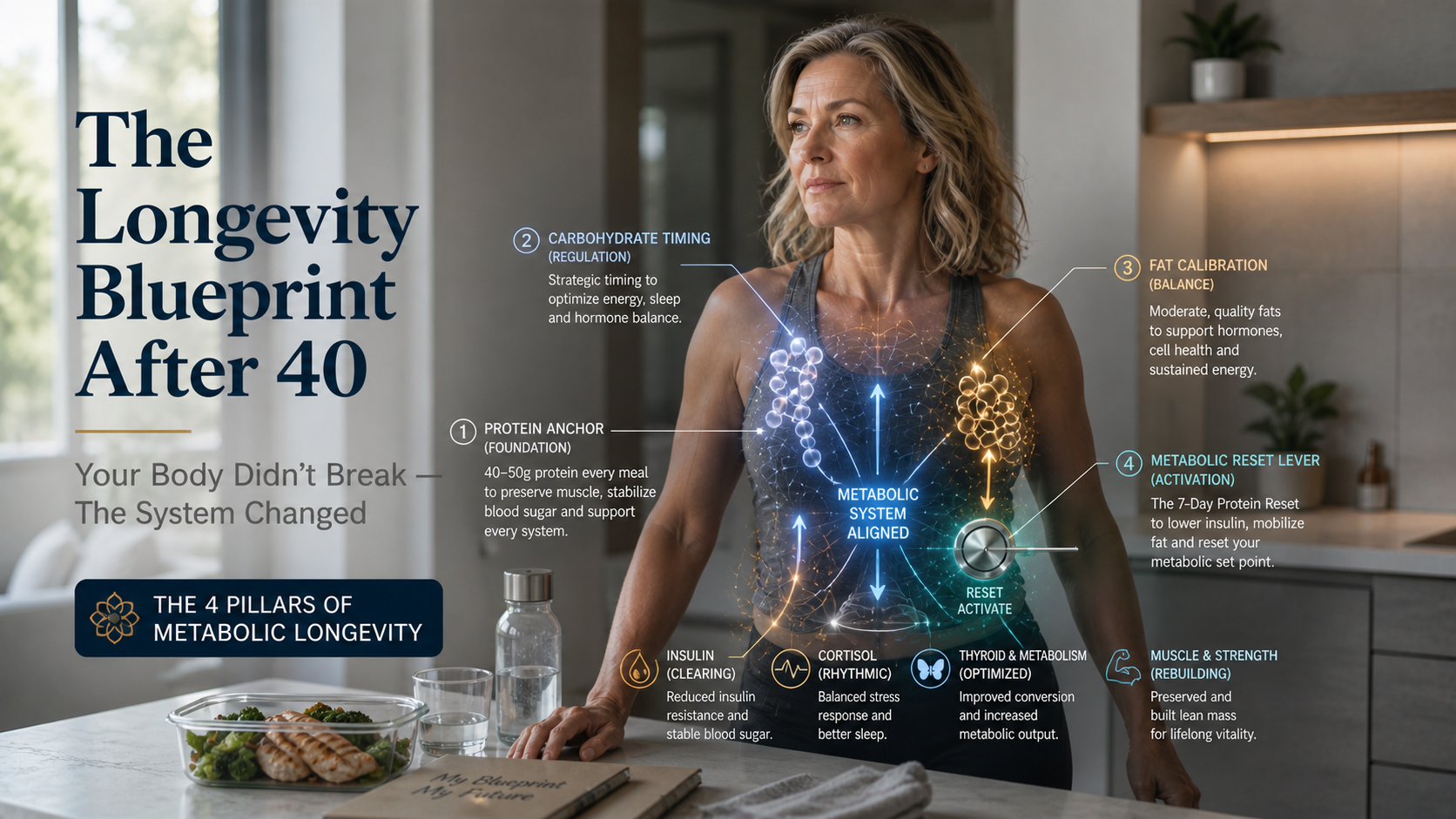
Pillar 1: Protein as the Metabolic Anchor
Every meal must begin with 40–50 grams of high-quality protein. This single habit is the most powerful lever I have ever measured for stabilizing blood sugar, lowering insulin, preserving muscle, and reducing the stress signal that drives cortisol. In perimenopause, progesterone decline removes a major brake on insulin. Protein anchoring replaces that brake. Patients who truly anchor every meal with 40–50 g of protein consistently report the fastest drop in belly fat, the most stable energy, and the biggest improvement in mood and sleep.
Pillar 2: Strategic Carbohydrate Timing
Carbohydrates are not the enemy in perimenopause — timing is. We keep them low to moderate during the day when insulin sensitivity is at its lowest and use nutrient-dense sources in the evening to support serotonin, GABA, and overnight repair. Women who follow this timing report fewer night sweats, better sleep, and a noticeable reduction in emotional reactivity.
Pillar 3: Fat as a Calibrated Tool
Fat is essential for hormone production and cell membrane health, but excess fat in the presence of rising insulin resistance creates energy toxicity. We use fat moderately and strategically so it supports rather than hinders fat loss and hormone balance.
Pillar 4: Nervous System and Sleep Hygiene as Non-Negotiable Levers
Perimenopause removes progesterone's natural calming effect. The nervous system becomes more reactive. Strict sleep timing (last meal by 7 p.m., lights out by 10 p.m., consistent wake time) and daily down-regulation practices become critical. Even 10–15 minutes of breathwork or outdoor walking makes measurable improvements in the cortisol curve and reduces night waking.
How to Work with the LCHPMF Foundation in Real Life — Week by Week
Weeks 1–4: Build the Protein Anchor Habit
Every meal starts with 40–50 g of protein. Breakfast might be a whey isolate shake with egg whites and spinach. Lunch is grilled chicken breast or turkey with non-starchy vegetables. Dinner is white fish or lean beef with a small serving of sweet potato or berries. Most women notice their afternoon crash disappears by day 10.
Weeks 5–8: Add Strategic Carbohydrate Timing
Keep carbs low to moderate in the morning and midday. In the evening, add a nutrient-dense source (½ cup cooked rice, a small sweet potato, or 1 cup berries). Night sweats often decrease dramatically during this phase.
Weeks 9–12: Layer in Nervous System and Sleep Hygiene
Enforce the 7 p.m. last-meal rule and 10 p.m. lights-out rule. Add 10 minutes of breathwork or a short evening walk. Cortisol patterns begin to normalize, morning energy returns, and emotional reactivity decreases.
Lab Context — What I Actually Order and Why
- DUTCH Complete test (gold standard for daily hormone and cortisol curves plus estrogen metabolism)
- Fasting insulin, HOMA-IR, HbA1c, and TG/HDL ratio
- Full thyroid panel (TSH, Free T4, Free T3, Reverse T3, TPO and TG antibodies)
- hsCRP and fasting glucose
Targeted Support After the Foundation Is Solid
- For high nighttime cortisol and poor sleep: magnesium glycinate 400 mg at dinner and ashwagandha KSM-66
- For estrogen dominance symptoms: DIM 200 mg and calcium D-glucarate 500 mg daily
- For low progesterone symptoms: bioidentical progesterone cream or oral micronized progesterone (prescribed after DUTCH confirmation)
- For thyroid conversion issues: selenium 200 mcg, zinc 30 mg, and a small amount of T3 if Free T3 is low
- For mitochondrial support when energy remains low: CoQ10 200 mg, PQQ 20 mg, and NAD precursors
All of these are physician-grade formulas available at drjaywrigley.com with your automatic 15% patient discount already applied.
Real Patient Outcomes
Sarah, 46, executive, mother of two
Sarah came to me after 14 months of plateau. She was eating "clean," exercising 5 days a week, and still gaining 1–2 pounds per month around her middle. Within 21 days of the full LCHPMF foundation her night sweats stopped, her energy stabilized, and she lost 7 pounds of visceral fat. At 90 days she said, "I finally feel like my body is working with me again."
Michelle, 49, teacher
Michelle had heavy flooding periods, breast tenderness, and afternoon rage she described as "not me." After 4 weeks of the LCHPMF foundation her periods lightened dramatically, the rage disappeared, and she lost 11 pounds without counting calories.
Lisa, 47, corporate attorney
Lisa had flooding periods, night sweats, 22 lb weight gain in 18 months, and rage that scared her family. After 12 weeks her periods lightened by 70%, night sweats stopped completely, and she lost 19 lb of visceral fat. She told me, "I got my life back."
Rachel, 51, teacher and mother
Rachel had brain fog so bad she was considering leaving her job. After 90 days her brain fog lifted, energy stabilized, and she lost 14 lb while gaining noticeable muscle tone. She said, "For the first time in years I feel like myself again."
Common Mistakes Women Make in Perimenopause
- Treating symptoms in isolation instead of the full cascade
- Going too low-carb too fast and triggering more stress
- Relying on willpower and calorie restriction instead of signal-based eating
- Ignoring sleep timing and nervous-system regulation
- Starting hormone replacement before fixing insulin and cortisol
Take the Assessment
The free 3-minute clinical assessment at Take the free Hormone & Metabolism Assessment will identify exactly which of the 14 archetypes are active in your body right now and give you a full Clinical Mirror report written in my voice. You will also receive immediate access to LEO — my AI clinical assistant trained on my 30 years of clinical data — who can answer your questions and guide you through the exact LCHPMF Perimenopause Blueprint tailored to your pattern.
The LCHPMF Perimenopause Blueprint is not another diet. It is a complete metabolic operating system designed for the exact hormonal environment you are living in right now. When you give your body the right signals in the right order, it responds. Energy returns. Mood stabilizes. Metabolism works with you again.
Start here: https://assessment.drjaywrigley.com
I read every single reply. I'm here to help you move through perimenopause feeling strong, clear, and in control.
— Dr. Jay Wrigley, NMD
Trusted Supplements
The supplements referenced in this article are available through Dr. Jay's practitioner dispensary.
Professional-grade formulations — the same brands used in clinical practice. 15% off retail, permanently. No membership required.
Browse Trusted Supplements →